Winter in Hokkaido


Hokkaido, Japan, is home to the indigenous Ainu people, where legend has it that one of their most revered deity’s was an owl called Kotan-Kor-Kamuy or "God that protects the village." Japanese folklore claimed its presence would bring good luck to hunting and fishing expeditions, prosperity, and ward off evil. It continues to be a symbol for the Ainu connecting the natural world with the human spirit - embracing their harmonious relationship. Such a noble title is not bestowed to any ordinary owl, “Oh no!” This is the world’s largest, it is Ketups blakistoni or the Blakiston's Fish Owl. With so many attributes, a trip to lay eyes on such a revered creature had to be pursued.
February 21:
Our trip began with us leaving the U. S. mainland; my flight from LAX-HND was just under 12 hours, covering about 5,500 miles. Jim flew for about 13 hours and 40 minutes from DFW to HND covering 6,400 miles. Overnight in Tokyo, and next morning a 1.5-hour flight to Kushiro, a city in eastern Hokkaido. Just outside of the airport, we had our first encounter with a Kamui, the fish owl! [However, it was in the form of a giant sculpture.] Then it was off in our car for an hour and half drive to Nakashibetsu, our base for the next five days.

February 22:
The first run for the day was to check out the Shibetsu River just outside of town. Any flowing river gave us hopes to find a ‘Dipper.’ Unusual among songbirds is its aquatic lifestyle, literally plunging into streams in search of food. Generally, after capturing prey it will hop up on a partly submerged rock or log to finish its meal. At times it seems to express its contentment with intermittent bobs or ‘dips,’ hence the name, Dipper.


From the bridge we did not find any such activity. But the tree-lined banks provide entertainment with a mixed flock of much smaller songbirds. Tits are most numerous as they make regular circuits searching for food among the treetops. This included Willow (Poecile montanus) and Asian Tits. Initially we thought the former to be Marsh Tits. [ Note, it is important to hone your auditory skills for such occasions – *Learn the bird’s songs! ].

Another diminutive relative joins the ranks, a trio of Long-tailed Tits (Aegithalos caudatus). This subspecies, caudatus, I feel is the most elegant – enhanced by the soft all-white feathered head and underside against a mixed black-and-white back and wings, with a splash of pink, all graduating down its long tail.

Granted the boughs are leafless this time of year but food can be found among the furrowed rows of bark or tucked within remaining leaves held in place by web spinning invertebrates. Ears tune in to rhythmic ‘wee-wee-wee’ notes that roll with the sound of running water - the vocalist, a Eurasian Nuthatch (Sitta europaea).

Harsh calls from Carrion Crows (Corvus corane) carry across the open fields of nearby homesteads.

A pair of Large-billed Crows (Corvus macrorhynchos) make their presence known and we use the opportunity to differentiate the songs of these two species of Corvids.

Doves and tree sparrows (Passer montanus) hang out in trees and along the frames of weathered shelters.

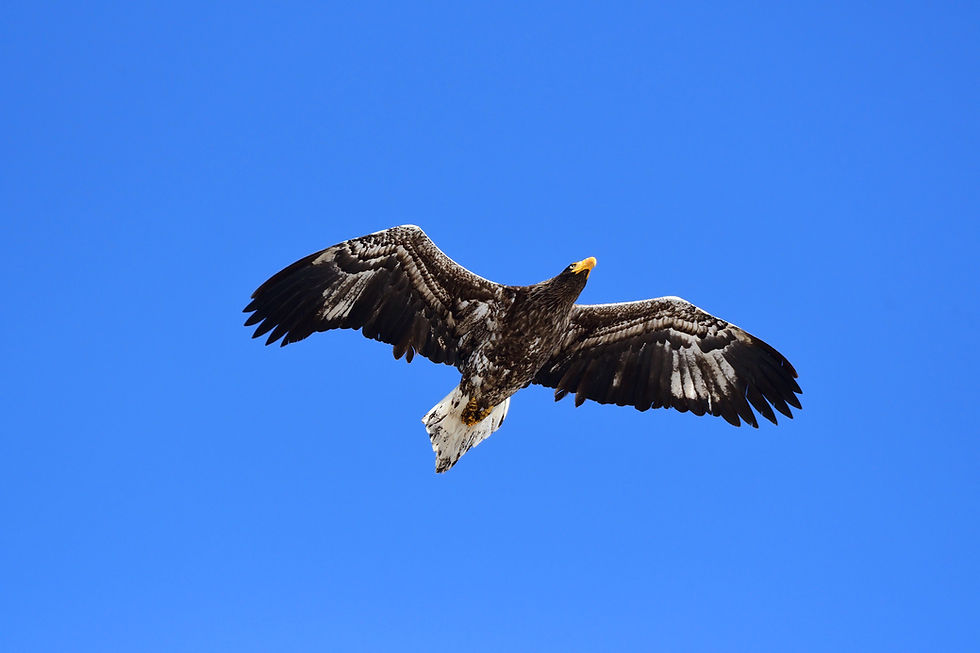
An immense ( or maybe I should say intense ) distraction literally flies in on seven-foot wings! As the **eBird Description puts it, “Looks like a flying barn door…” I refer to the White-tailed Eagle (Haliaeetus albicila) It lands along the back side of a small patch of trees but does not allow us to venture close for a better view; it takes wing, "What an impressive bird!"

On our way back to the car the distinct chattering notes of a Dusky Thrush (Turdus eunomus) leads us to three birds perched in a tree. The birds take flight across the road where one alights on a power line - a great photo op but not quite the natural setting one would hope for.

Back at the wooded edge we turn in response to the buzzy trill of a Japanese Pygmy Woodpecker (Yungipicus kuzuki). Having bundled up against the winter’s chill, it is humbling to observe the energy of these tiny birds ‘playfully’ going about in their daily routines.

The roads have been well maintained with no accumulation of snow, but the country-side is submerged in a sea of white. From here we head toward the southern base of Mt. Shibetsu, more specifically, Yoroushi Onsen (養老牛温泉) Hot Spring. The natural hot springs is something I most definitely can warm up to but I am focused with hopes for some new sightings for the day. Who knows, perhaps our paths will cross with a roosting owl!? We leave the car park and round a wall of snow. Anxiety with each step surges with the approaching sound of running water. I check from atop the bridge, Jim heads down the trail. We both check the stream for any activity. Shortly, Jim shouts out, “Al, over here!” Oddly I see him looking in my direction. Once I reach him, he points, “There, under the bridge, a Dipper!” I reply, “Cool!” and start to retrace my steps until the bird flies downstream.
Brown Dipper (Cinclus pallisii)

So it is back on the trail and into the forest. Another set of little gnomes greets us, that is, several Willow and Asian Tits bouncing in rhythm to the songs of a nuthatch and pygmy woodpecker duet.


The compression of snow with every step sounds like the grinding together of two pieces of Styrofoam. We trudge on until a chiseling sound has us pause. We listen and realize it is coming from behind a large snow drift. The bird pops up briefly only to drop behind cover once again. It looked like a Great Spotted Woodpecker (Dendrocopos major), it then flies across the road ahead of us and perches on an exposed limb. Affirmative, highlighting this tranquil winter scene is a beautifully marked female. “Nice!”

We return with my hopes of capturing an image of the dipper.
So we both clamber up a snow bank over the bridge for a better perspective and wait. The bird’s ‘zeet-zeet-zeet” notes echo from under the bridge where it emerges and obligingly lands out in the open. We watch it for some time as it comes and goes from under the bridge; we concluded it probably has a nest under there. It was interesting to see its ‘white’ eyelid on several occasions. I read that this evolved as a visual type of communication due to the loud noise of running water.

A troop of Eurasian Jays (Garrulus glandarius) sallies in, to my surprise one bird decides to take a bath!

I have multiple layers of clothes on and the last thing I would want is to get soaking wet! This race called Brandt’s (G. g. brandtii) has an ochre-colored facial area compared to the subdued brown of the nominate race. I mention to Jim when the bird raises its head feathers that it reminds me of a laughing thrush… […found in more tropical climates.].


Our intentions were to continue up through the mountain but the snow ploughs only went a mile further and stopped. So we head back to connect to the 950 via route 244, taking us to the Notsuke Penninsula. The plan is to make intermittent stops along this 14-mile (23km) strip and scope the area with hopes of a pelagic bird or two. On the inner side we stop to look at two clumps of white out on the ice; it turns out to be my first encounter with the Whooper Swan (Cygnus cygnus).

Another stop at a car park we scope the steel blue waters of the Pacific.
The Kuril Island Chain can be seen off in the distance.

This vantage point has very little activity, mostly Slaty-backed Gulls (Larus schistisagis) drift past...

...with an occasional Pelagic Cormorant (Urile pelagicus).

Angling into the stiff ocean breeze, a Black Kite (Milvus migrans) twists and turns its way up the coast.

With a couple of more stops we tally a White-tailed Eagle (Haliaeetus albicila)...

...Red-breasted Mergansers (Mergus serrator), Male and Female,


and a Black Scoter (Melanitta americana).

This peninsula is basically a sandy-rocky strewn beach.

Sediment deposits through the ages has established grasses and sedges attracting its subsequent wildlife. Yezo Sika Deer (Cervus nippon yesoensis)...

...and the Ezo Fox (Vulpes vulpes schrencki) are quite numerous and indifferent to human activity. This is the “Go-to!” spot to photograph these endearing animals.


We do not go to the tip due to time constraints, but our termination point presented us with a colorful flock of Asian Rosy Finches (Leucosticte arctoa).

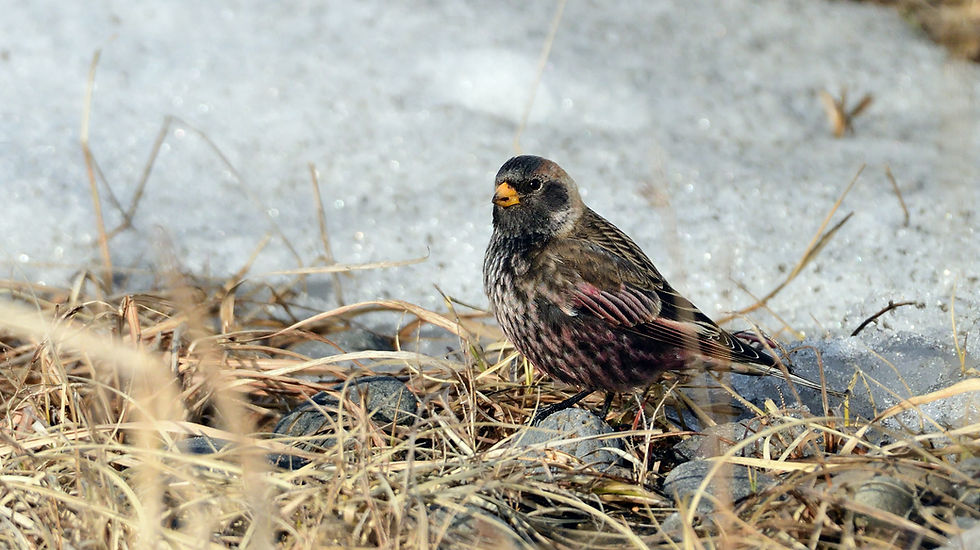
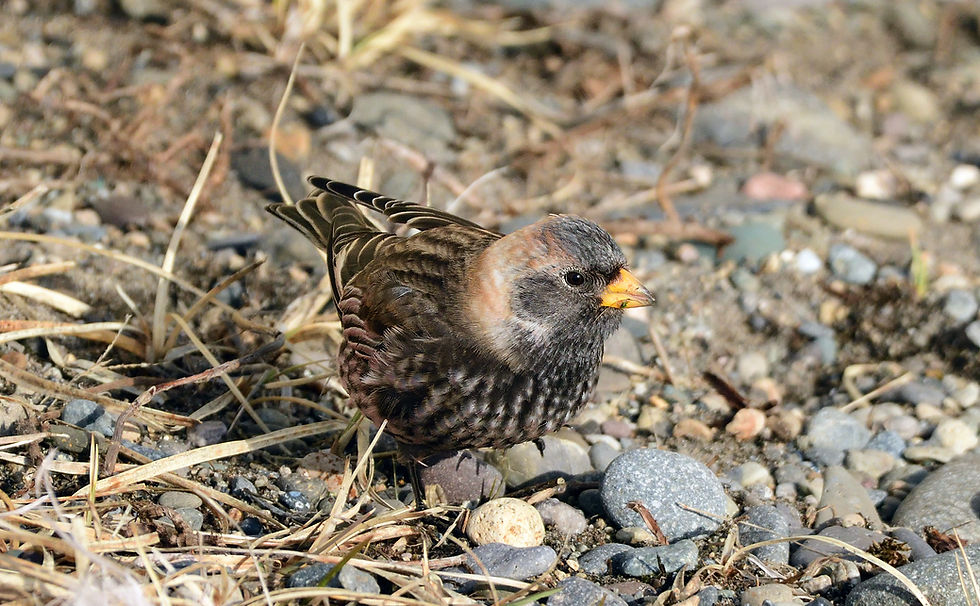
On the return drive I get my first look of a Steller’s Sea Eagle (Haliaeetus pelagica) – granted it was perched a long way off but its stature and black-and-white vestments left no doubt as for its identification.
February 23:
Today it is a visit to the opposite side of the Notsuke Peninsula towards the eastern side of Lake Furen.
Various gulls cruise past, mainly Glaucous (Larus hyperboreus) and...

...Slaty-backed (Larus schistisagus),

but one or two of Black-tailed (Larus crassirostris),

Vega, Common (Larus canus kamtschatschensis)...

...and Black-headed (Chroicocephalus ridibundus).

To our delight, a nice sized flock of Greater Scaup (Aythya marila) fly past.

Fast-flyers in the form of Common Goldeneyes (Bucephala clangula) zip past in either direction. Here is the drake going north...

...with the hen heading south. [Marital problems?]

Onto (Literally, we hope!) Lake Sunset where the eagles hang out along this body of water. The eagles have learned that a fish bonanza is regularly offered out on the frozen lake. A local gentleman will toss out fish to bring the birds in for the enjoyment of paying bird watchers, photographers, or simply those who just want to see an impressive display of nature up close. It turns out we are late for the performance as the ice is too thin, it has begun to retreat with warmer temperatures and deemed unsafe. I could only imagine dozens upon dozens of these magnificent creatures circling overhead and swooping in for a meal.
Trees on both sides of the water host multiple eagles while others wheel about with their 6-8 foot wingspans.
[SSE] Steller's Sea Eagle (Haliaeetus pelagica)

[WTE] White-tailed Eagle (Haliaeetus albicilla)

Various shapes of white collect along the edge of the ice shelf. One is a large raft of Common Mergansers (Mergus merganser) which take to the air...

...the other gathering sleeps on top of the slippery surface – Whooper Swans (Cygnus cygnus).

In the foreground irregular bursts of light reflect from the small pools of water. Here a statuesque pair of Red-crowned Cranes (Grus japonenesis) search for food.

We drive a short distance and check out the Shunkuntai Nature Center; it sits on a bluff overlooking the water and there are clearly marked trails in the adjoining forest track. The Center is very informative and the staff are very accommodating. We visit the tree-lined paths first. Deer seem detached with our presence and continue with their grazing.

We come across the regular winter birds; tits, nuthatch...

...and three types of woodpeckers: Japanese Pygmy...

...Great-spotted
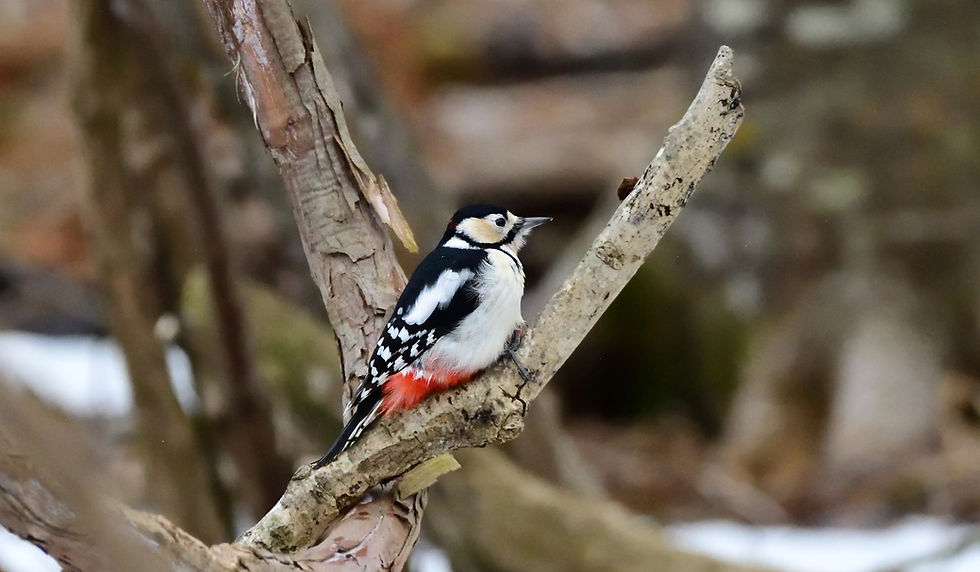
...and for both of us, a first encounter with a White-backed (Dendrocopos leucotos).

A farewell encounter with more deer and...

...its back on the road. We make a quick pull over for a trio of Whooper Swans. It appears to be two parent birds with a juvenile.
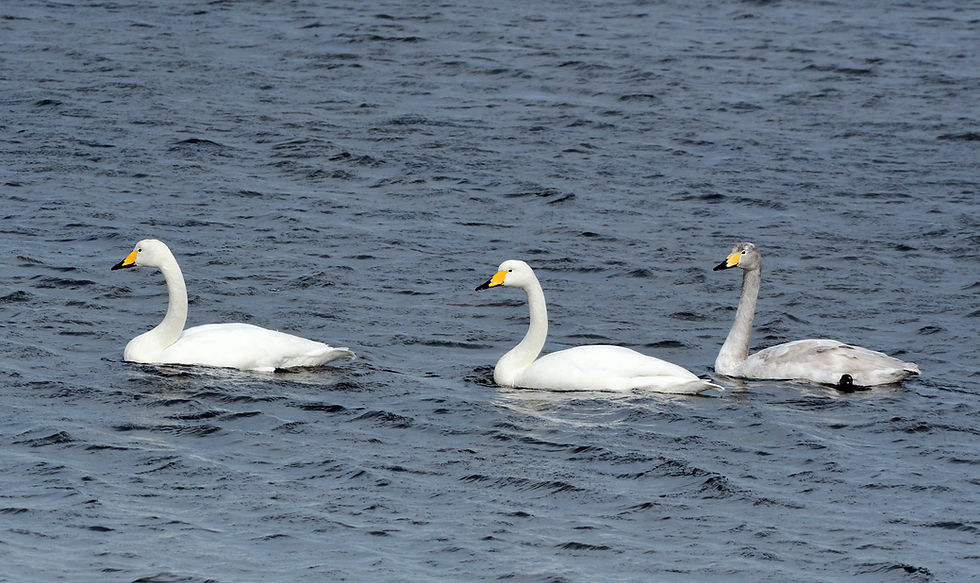
The birds are indifferent to my presence as I am able to walk along the shore and capture their behavior.


The decision is to continue up Nemuro Bay but we first make a dogleg to Hanasaki Port, where a network of docking stations allows for some nice sightings. I cannot think of a better word to describe what you feel when observing one of the most colorful sea ducks, the Harlequin (Histrionicus histrionicus) drake, other than “Captivating!” It has an overall deep, slaty-blue body with a thick white strap around the neck, lower breast, and diagonally along the back – each bordered in black. Another vertical stripe is situated just below its spherical ear patch. The clown-like face has a very large white crescent that tapers as it climbs up to the crown. This is highlighted by a chestnut brow and a thick, black central crown stripe that symmetrically divides this pattern when viewed head-on. Chestnut flanks round out this little piece of art.

Another diving duck with an intriguing design is the Long-tailed Duck (Clangula hyemalis) more so in its non-breeding plumage. We managed a sighting; however, these handful of ducks were quite distant.

The yellow-and-black parking blocks along each wall often accommodated various species of gulls - the usual Slaty-backed...

...with some Black-tailed.

Sculling the choppy waters was a well-marked, Red-breasted Merganser.


Not far away, on the reverse side of the spectrum was a non-breeding Pelagic Cormorant.

And of course, it seems everywhere we go there is always the ubiquitous Carrion Crow.

At the easternmost point of mainland Japan is Cape Nasappu. Across the Nemura Strait sits Kunashiri Island; ***disputed territory between Japan-Russia.

At its rocky cliff face sits a wooden blind - a much-needed windbreak from this windswept coast. A birding couple had been in the blind all morning and saw several different alcids. During our stay we managed a long-distance scope-view of a Spectacled Guillemot. Harlequin Ducks were most prevalent; I stopped counting after 100 birds.

Other water birds included Black Scoter,

Long-tailed Duck, Pelagic Cormorant and a Black-necked Grebe. A steady flow of gulls allowed some nice views as they maneuvered effortlessly along the rugged sea cliff.
Glaucous Gull (Larus hyperboreus)

Glaucous-winged Gull (Larus glaucescens)

Slaty-backed Gull (Larus schistisagis)

February 24:
Today it is back to the coast with a different location, the Shibetsu Port; where fishing boats dock, gulls will be found with many small flocks and congregations of Slaty-backed!

Ledges on the bay walls were a prime roosting site for Pelagic Cormorants.

Drifting alongside the boats was an assortment of waterfowl: Eurasian Wigeon (Mareca penelope)...

...scaup, harlequin, merganser (Mergus merganser)...

goldeneye and Tufted Ducks (Aythya fuligula).

From here it was north to Rausu; we wanted to get an idea of the driving time for
tomorrow’s boat trip.
The road splits just prior to taking the bridge over the Rausu River,. You take Rt. 87 to go inland towards the Shiretoko Mountains, as for us we keep to the right on Rt. 335 into the heart of the village. The town is limited to expansion due to the limited amount of shoreline; it backs up to steep mountainous terrain.
View taken from our boat tour; behind the eagle is the heart of Rausu.

The name of this settlement is a derivative of the Ainu word, Raushi, with one translation being, “Place of men with beast-like spirit.” Today’s inhabitants maintain this philosophy, embracing the natural cycles of life and live accordingly. Sustenance, as well as one’s livelihood, comes from the sea – that goes for the eagles, too. The birds are revered as can be seen when crossing the Rausu River Bridge - a pair of bronze eagle statues welcomes you with open wings.
We stepped out at Misakicho Harbor into a maelstrom of activity; it was a flurry of screeching gulls filling the sky...

...while others clashed from atop the metal roofs or along the seawalls...

...and all the while an eagle or two would cast a shadow from overhead.
SSE immature
It was hard to part from such activity but the plan was to continue as far north as possible. From that direction, a low-pressure system began to build in intensity. We parked across from Tengu Rock and just as we stepped out, it began to snow. At the summit, gulls quarreled amongst themselves for the title, ‘King-of-the-Rock.'

With a nickname like ‘glacier duck,’ the Harlequin is indifferent to harsh conditions; they were skating across the surface and bobbing between the rocks.

The skies were gray but we were determined to push forward. Shiretoko Rausu Visitor Center was our next stop. Sadly it was closed, opening in April. “Onward!” Well, not exactly. Once again, the road terminated. Perhaps it was an omen to avoid driving through inclement weather.
There are limited stops on the way back to Nakashibetsu so we check the map and find a road heading inland. “Let’s give it a try!” As it gradually ascended it transitioned to forest where evergreen trees are more evident. We are entering the Kanayama Keikoku Valley via Rt. 244.

Parking is limited to where the snow trucks have cleared enough space to park. We find an actual parking area and with ears tuned in and eyes focused, continue further up the road on foot. This habitat should have Black Woodpecker. This turns out to be our most productive spot, finding the usual forest inhabitants with a debut by a White-backed Woodpecker...

...and that of a foraging jay. No Black Woodpecker today.

It was surprising to see a handful of eagles high above the forest – perhaps the water course was the draw.

Tracking a SSE through the pines presented an image of how it might look on its breeding grounds in Russia.

February 25:
No matter what the ice-packed ocean throws our way, today’s boat trip is going to be an adventure. This time our stop in Shibetsu is the aptly titled Seaside Park. A cement promontory juts out into the ocean isolating a portion of the beach and creating a wind-protected cove. Here we find more Goldeneye,

scoter, wigeon, a Red-breasted Merganser and of course ‘totem pole duck.’ (One of many names for the Harlequin Duck). A pair of kites glide harrier-like along the seashore.

The eastern facing wall is a roosting site for the cormorants, not only as a windbreak but a place to absorb the heat of the morning sun.

We pass what appears to be a large marsh on the inland side of Rt. 244. A quick 180 and we turn in at the sign welcoming us to the Shibetsu Wetlands. The buildings are closed for the winter as is the gate to enter the marsh. There is obvious foot traffic on the other side so, “Let’s check it out!” An elevated trail merges into a boardwalk that crosses the swamp and continues into the forest.

Crossing a section of open water we inadvertently flushed some Green-winged teal and Eastern Spot-billed ducks. The combination of crunching snow from underfoot, the tinkling of avian song among the trees with moments of silence, has an inner sensation of warmth take hold; it was as if I reverted to hiking the forest preserves back home. It became further ingrained when finding these mixed flocks of birds that looked, sounded and behaved like those back home, too. When I first heard and then spotted a Eurasian Creeper (Certhia familiaris), it felt like I was looking at a Brown Creeper, I knew otherwise because of where I was geographically – fun stuff!
Believe it or not but the creeper is located dead center in this image.


Here is a better image of this camouflage creeper.

Inside the forest there is an area called the Shibetsu ruins grouping. It consists of pit dwelling foundations with some reconstructed homes that date back thousands of years. It appears these were temporary structures used during the fall migration of the salmon run. The structures meld brilliantly into their forest habitat, and as you can see, each is constructed from materials found, literally, just outside the front door.

“Rausu, here we come!” Passing through town we park in an extended driveway to scan the ocean. Until I saw the sign, I did not realize this was the entrance for ‘the’ site to view the Blakiston’s Fish Owl, the infamous "Washi-no-yado Inn." So, we drove down and spent an hour there because eagles were all over the place! The Inn is located alongside the Chitorai River (It looked more like a mountain stream) where these birds-of-prey appear to roost.
White-tailed Eagle's


Steller's Sea-eagle


A resident dipper has selected a nesting site across from the lodge.

I was told that reservations are booked a year in advance to see the owls! So when we went inside to inquire (Beg, if necessary) if it were possible for us to hang out here tonight; we were beside ourselves when they gave us a nod of approval! Granted, a fee was involved, but this is the owner’s livelihood after all. “All right!” The day just keeps getting better! Time to grab a bite before setting sail.
It is half past twelve, we are standing in front of Hiro’s office. You cannot miss the place; hovering over the shop is a life-like effigy of a Sperm Whale. I am concerned as there is no one else around. I check the door and it is locked.

We glance back towards the wharf and see two, double-decker boats filled with people – all having donned orange life vests. I call Hiro and he tells us to quickly head in that direction. We are met part way, are led to our little boat, “Oh!” I thought to myself, then don our vests. Two camera-toting Japanese men had already boarded. Hiro, the last to board, unlashes the rope and with a nod from the captain (I believe it is Hiro’s wife) off we go. We could probably fit another four adults comfortably. Yes, we had a small boat but after looking at the mass of people on the other two, we made a good decision. There was a slight breeze, very calm water, so the pack ice remained a short distance from the shore. Conditions were ideal.
"Off we go!"

We could see the ice pack dotted with ominous dark figures, eight-foot wingspans cruised overhead - it seemed that eagles outnumbered the tourists!.

Even though I knew what to expect, it had that ‘in-the-moment feeling.’ You have no thoughts, your mind is empty, your eyes and ears are like that of a child entering a ballpark for the first time.
Our first encounter is with a White-tailed Eagle [WTE].

Our little dinghy would slowly glide to the edge of the floating ice where the throttle slowly idled to maintain our position. That is when Hiro went into action, tossing whole fish onto the ice with his modified lacrosse-like stick. Once several birds arrived, it was a signal for others to follow. The eagle’s beaks were impressive; they would carve up their foot long meal in no time. The Steller's Sea-eagle's [SSE] beak could measure over four inches from the gape to the tip of the bill and be up to three inches thick! Now add on that exaggerated hook and it was outright intimidating!


There wasn’t a minute that the shutter was not snapping away, anywhere I turned, something held my focus.


Often times the SSE would bully the WTE. On one such occasion a bird managed to grasp the other’s leg in mid-flight, forcing it to relinquish its meal.

On the flipside, a feeding WTE made it quite clear to a youngster to, “Back off!” by cocking its head back and letting out a series of ‘feather’ raising cries!

Sometimes the birds are so close it is difficult to keep the entire bird in the frame!

Sometimes you get lucky!

The Slaty-backed Gull was another opportunist, trying its best to snatch a fish and swallow it whole. One bird managed to get a good ‘beak’ hold, got airborne and swallow the fish before being mobbed by other gulls.


We felt our small boat was the better choice. The larger boats plowed into the drift ice and stayed pretty much in one place. We skirtted along the periphery and saw more action and more birds!

It was hard to turn back but Hiro kept tossing out fish to keep us entertained.


As the boat came closer to shore small groups of Harlequin and Tufted Ducks were trapped between other boats. Their sanctuary was the open ocean. So alongside the boat they flew, allowing me the opportunity to capture the action.

Tufted Duck (Aythya fuligula) Female


Walking back to the car I tell myself, “Now I understand!” After experiencing this last event, I now knew why my friend’s [Who already have made this trip.] became so passionate when recalling their experience.
Our plan was to bring some food for our next stirring episode tonight; however, we had time for one last ocean view. The number of sightings of Painted Ducks [Another apropos sobriquet for the Harlequin Duck] seems to have increased with the progression of each day. And here at Cape Sashirui it was no exception.

We turn around but so too has the landscape. A massive floe of ice slowly crept in and the open ocean has ceased to be!

Jim added another species to the list, a Glaucous-winged Gull (Larus glaucescens).

Off to grab some food and head over to Washi-no-yado. We park the car and carefully slide our way over to the Inn. A modest banquet was in full swing for the paying guests as we were escorted out the rear of the cabin. Our viewing area was a defunct bus situated at a bend in the stream. Our view was perpendicular from that of the guesthouse.

The staging area for the owls is directly in front of the guesthouse as evident with two large tripods, each supporting a spotlight.
Inside, along the length of the bus stools were aligned with each having a sliding window. It could accommodate six comfortably, two more would make it quite cozy. From each end of the bus a propane heater was ignited. It was just the two of us. “O.K.!”

An island of rocks was designed as a holding area / it could be a funneled trap for unsuspecting fish, too. Either way we got comfortable and waited for the sacred guardian to arrive.
We waited and waited. “Is someone going to bait the pool with fish?” We wondered. After some time the owner’s wife steps out but gets into her car and drives off. We joke, “Maybe she is going to get the fish?” We wait, she returns, enters the lodge, we wait, nary a soul transpires. One heater runs out of fuel and then the second one shuts down. The winter night’s chill is now apparent. Still, we sit tight and hope for the best.
Finally, the curtain is drawn, kotan koru ekashi remains an enigma; we were inspired by the aura of folklore and the storied tales from friends. Someday, too, we hope to witness this cultural icon of the Ainu people.
February 26:
Our last day had an early start back to Kushiro. Jim wanted to check out a reserve near our destination. It was too early for the Center to be open but we discovered it was closed permanently for trail maintenance. Earlier we passed another entrance so we turned back to realize it too was closed. An illustrated sign disclosed the trail closures but it highlighted the major loop route as being open. Stairs descended through a small patch of trees which hosted another enthusiastic party of avian aerialists.
Willow Tit (Poecile montanus)

Long-tailed Tit (Aegithalos caudatus)

Eurasian Nuthatch (Sitta europaea)

Eurasian Creeper (Certhia familiaris)

Great Spotted Woodpecker (Dendrocopos major)

The setting was very similar to the Shibetsu Wetlands, however, the majority of the snow-covered boardwalk led out to the marsh. Our boots set the tone with each step on compacted snow but they suddenly go silent. Far off in the distance a bugling pair of Red-crowned Cranes bow and spread their wings - winter in Hokkaido at its finest! Yet another dreamlike setting is hidden in a cove, where we startle a second pair that bursts into the air. Carving a path across a wooded hillock, black-and-white wings airlift their slender bodies, taking them out into the field and beyond.

Finally we stop at the Akan International Crane Center; it is only 20 km from the Kushiro Airport. Often times referred to as Japan’s “Snow Ballerinas,” this location guarantees that you will see the Red-crowned Crane, up close. The birds are seen year-round but the winter months has the greatest number of birds. We counted over 50 individuals and even more Whooper Swans. I will forever recall listening to them bugling as they leap and whirl about in these snow-covered fields.

The cranes subsist on corn provided by the Center.

Whooper Swans have also learned about this offering and have become regular winter visitors as well.


"Dance of the Snow Ballerinas" continues throughout the day.

At times during their dance, a bird gets so excited that...

...one bird will move off leaving the other to continue its courtship dance.

...but it will come racing back if its partner begins to wander to far off.

It is an impressive bird when it takes flight with a wingspan just shy of eight feet!

Especially when birds fly right along side of you!


Sayōnara, soshite arigatō Hokkaido!
Location: East Coast of Hokkaido, Japan
Date: February of 2026
Other websites:


Comments