Lamington National Park

Updated: Aug 30

When driving through mountain slopes of eucalypt forest, with Pretty-faced Wallabies (Natamocropus parryi) greeting you along the way, how can you not be anxious - especially after a thirty-six-year hiatus!


We make a sudden stop for the presiding ‘King of the Road,” an impressive Lace Monitor (Varanus varius), then slowly creep forward to persuade it to give up the throne.

A gain in altitude realizes a greater variety of trees, where cooler moist air hosts rainforest species of ancient lineage. This is the McPherson Range in southeast Australia, the location of Lamington National Park - O’Reilly’s Rainforest Retreat at about 900 meters is where the road ends. The Albert’s Lyrebird, Noisy Pitta and Paradise Riflebird are birds highly sought after in these ancient forests. It is Brisbane’s premier birding ‘Hotspot!’

Once parked we stroll the grounds; it seems there is a constant barrage of brightly painted aerialists. Crimson Rosella (Platycercus elegans) and Australian King Parrots (Alisterus scapularis) will alight on your shoulder or an outstretched arm looking for a free handout.


Perched in the nearby trees are Regent and Satin Bowerbirds.
This is the male Regent Bowerbird (Sericulus chrysocephalus)


Regent Bowerbird - female

This is the male Satin Bowerbird (Ptilinorhynchus violaceus)

Satin Bowerbird - female

Hopping about at a regular feeding station are Red-browed Firetail (Neochmia temporalis)...

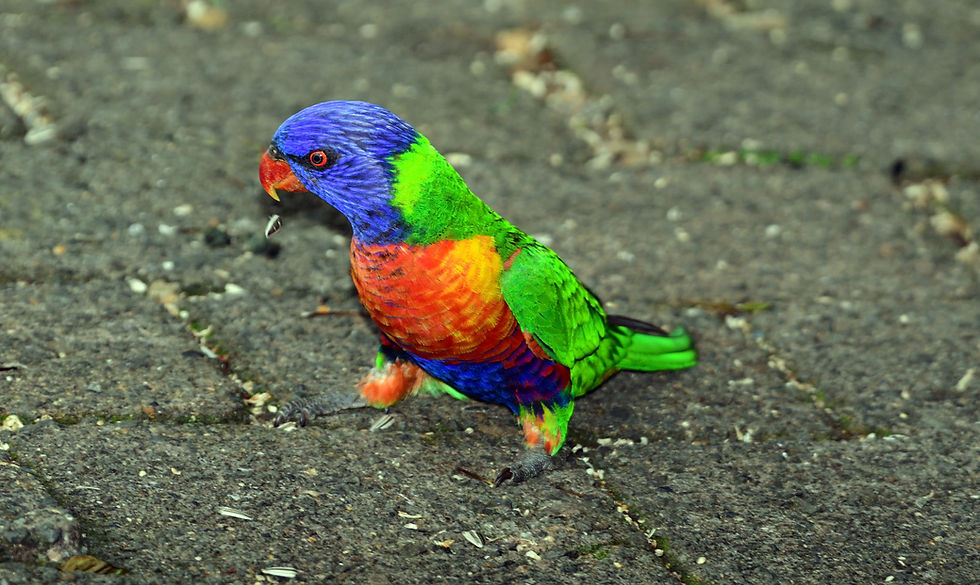
...and aptly titled Rainbow Lorikeets (Trichoglossus moluccanus).

A plump Wonga Pigeon (Leucosarcia melanoleuca) nonchalantly joins in the feast.

Australian Brush Turkeys (Alectura lathami) patrol the premises; its bright yellow neck wattles are like a scarf that appears to have been wound too tight causing its face to flush a bright red.


At times, a black-and-white missile parts the sky in the form of a Pied Currawong (Strepera graculina), in contrast...


...Welcome Swallows (Hirundo neoxena) sweep the air with precision acrobatics.

Strong winds greet us at the trailhead, making sightings more difficult. Fortunately it did subside, allowing us to discern movement and locate the source of avian song.

Mid-canopy songsters include Australian Golden Whistler (Pachycephala pectoralis) and...

...Brown gerygone (Gerygone mouki).

They are accompanied by ground dwelling chatter from Yellow-throated Scrubwrens (Neosericornis citreogularis).

My favorite? The Eastern Whipbird’s (Psophodes olivaceus) duets that ricochet off the trunks of trees.

The forest is in constant flux, even though this is one of the most ancient rainforests in the world: These trees presage the split of the supercontinent, Gondwana, we are talking about hundreds of millions of years ago!

A cooperative Russet-tailed Thrush (Zoothera heinei) hops about at the start to the Booyong Walk.

Standing sentinel along the boardwalk is a dapper Gray Shrike-thrush (Colluricincla harmonica).

It sallies down the ravine flushing an Eastern Yellow Robin (Eopsaltria australis).

These birds are accustomed to human presence; it is almost as if the birds are begging to have their picture taken! Even those rummaging in the darkest corners, like the Australian Logrunner (Orthonyx temminckii)...

...and Whipbird, allow close approach.

Now only if the Noisy Pitta was in the same mindset; we heard a good number of their three-note calls but never in close proximity.
Each trail has markers adjacent to a notable species of tree, generally one of stature – many are real giants! Along with a brief description, it gives the specimen’s Common, Latin and Aboriginal name. Some of Australia's largest conifers can be found here. My favorite is Araucaria cunninghamii, the Hoop Pine; its huge bulk and enormous totem-like trunk will shoot straight through some of the highest canopies. Its trademark is the dark brown, scale-like bark that forms horizontal hoops.


I have vivid images of peering up the trunk in a heavy downpour while in the jungles of New Guinea. I reached out and placed my hand across its gravelly exterior as tiny rivulets cascaded down; it provided a sense of reassurance; it was a talisman, a stalwart landmark that gave me perspective. Here is the rest of the story: Our porters were leading us up to our campsite to plan an early morning venture to find the Vogelkop Bowerbird. Every fifteen to twenty minutes I noticed a solo Hoop Pine straddling this ridgeline. Having veered off from the others, I was now trekking alone in the Arfak Mountains of West Papua. Hours passed and dampness began to creep under my clothes - that triggered the need to search out one of these landmarks to guide my way back. While on this lower shelf I made certain to always keep an eye out for one of these trees, a reassurance of location. It came time to tuck away my gear and focus on my return. I felt confident it was a logical decision and eventually calls from one of my colleagues helped insure I was heading in the proper direction. Needless to say, I have a sentimental affinity for these ancient giants.
Back to Aussie land - the only honeyeater we encountered so far was its rattling song, but when we emerged from the forest, a fine-looking Lewin’s Honeyeater appeared – indifferent to the constant flow of visitors.

"Talk about indifference!"

It was time to refuel, and as if on cue, one of our feathered friends made a beeline to the Mountain Café and Gift Shop, so we followed suit. It appeared the avian community had no qualms bringing their ostentatious behavior inside.

One of the cooks had to take to fencing, branding his spatula like an epee to thwart the advance of aerial attacks. My good friend ordered his cuppa while I claimed a bench outside. Carving its face across the horizon are the mountains of the Scenic Rim, in the foreground lies a commanding view of the Albert Valley.

Adding to its grandeur is the line-up of ‘in-house’ entertainment: a constant flow of parrots, crows (Corvus orru), and currawong seek an easy handout...


...but when a male Satin Bowerbird peered from around the corner, well, “What can I say!”

We reflect on past exploits while watching Welcome Swallows etch elaborate flight patterns over this panoramic view.

A surprise, “Topknots!” They zip past before I have a chance to get my bins on them. Another unexpected sighting comes sailing in, Australia’s largest raptor, a Wedge-tailed Eagle (Aquila audax). Later I was informed it is a captive bird used not just for entertainment but educating the public on conservation.

It is back down the road in anticipation of more surprises. The sun-filled gap kindles activity with various invertebrates. On some exposed leaves sits a shiny blue damselfly and a colorful wasp.
Whitewater Rockmaster (Diphlebia lestoides)

Thynninae species

Brown Gerrygone and Large-billed Scrubwren (Sericornis magnirostra) energetically comb through the vegetation.

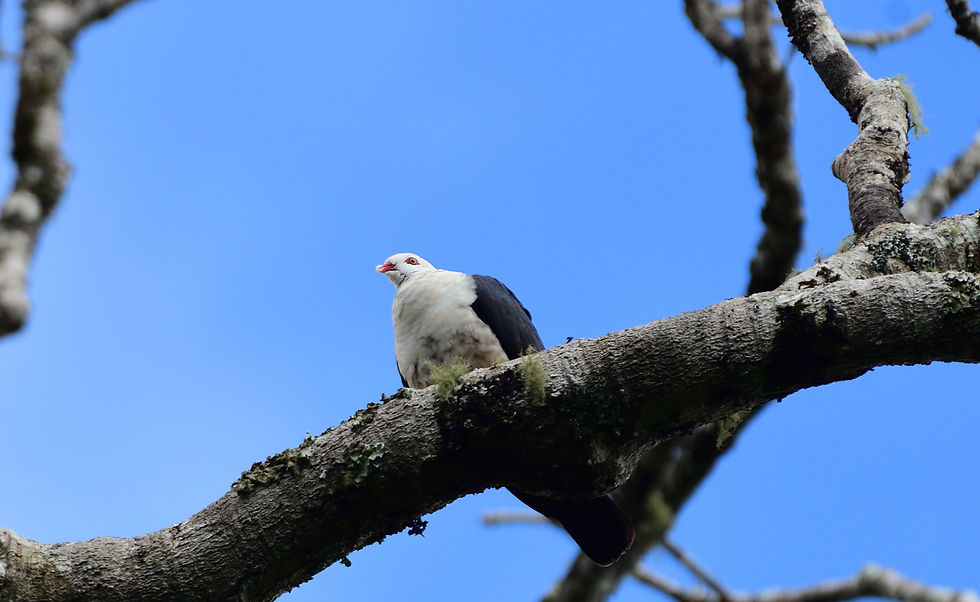
A pair of single deep ‘whoo’ calls boom from the canopy, another bird responds nearby. We wait with hopes of a sighting and are rewarded for our patience – White-headed Pigeons (Columba leucomela).

We also hear the call of the Brown Cuckoo-dove which has a higher tone with an upward inflection. There are generally two introductory notes which requires closer proximity for it to be heard.
Colin points out the other Columbidae to be heard and their respective calls. There is the repetitive higher toned ‘woo-woo’ notes of the Wonga Pigeon; the guttural ‘Wam poo” of the Wampoo Fruit-dove and the unpigeon-like notes of a Topknot – for me it sounds like someone briefly smoothing out metal burrs on a grinding wheel!
I pause to record an unfamiliar song; it begins with several twittering notes followed with two ascending trills – Colin cannot quite place it. We ramble on picking out another Noisy Pitta calling in the distance; some more Topknot Pigeons sweep over the canopy. “Wait a minute!” Colin says. “I know that song,” referring to my recording. “That’s a Rose Robin!” Heading back we were tormented by the bird crossing the road on two occasions;

We could not pinpoint the song with any movement across the canopy. It would have been nice to have seen the male in breeding plumage. **I recommend you look it up.
Heading into the shadows via the Burra-Burra Trail leads to more encounters with sign-markers regarding the ancient forest inhabitants. Before me a stately Black Booyong spreads its buttressed roots to maintain a strong foothold on the forest floor.


Centered along large branches or wedged in the crotch of trees are various types of large ferns, like the Bird’s Nest (Asplenium nidus)...

...and my favorite, the Staghorn (Platycerium bifurcatum).

A Black-faced Monarch (Monarcha melanopsis) calls our attention as it flits from under the canopy. Another bird pursuing a meal comes down giving us a closer look.

A sprightly pair of Australian Rufous Fantails (Rhipidura rufifrons) make a brief debut.

Skyward, the plump bodies of Green Catbirds (Ailuroedus crassirostris) can be seen silhouetted in the fretwork of leafy boughs; they cry out with ‘meowing-like’ calls while in search of fruits.

Moving slowly we continue to scan for any movement until the sound similar to large drops striking a leaf diverts us back to the trail; it is scattered with tiny fruits. Ahead are the buttressed roots of a massive fig tree, its far-reaching crown is the source of this free-falling fruit diversion.
Earlier, off in the distance, we heard the gruff gobbling call of a Wompoo Fruit Dove. Now, a large Columbid-shaped bird just flew in so our hopes are high. Frustration sets in after rubber-necking this way and that for a small ‘window’ of opportunity. “I got it! Over here!” Now follow closely, this is how you get a fellow birder locked-in for a sighting: “Alright, stand in front of me.” You position the observer. Choose a point of reference, “Follow the fig tree up to the largest branch to the right, go about halfway up its length just before that large clump of moss.” Pause. “Now go up 10 o’clock about five feet to that small ‘window’ – look for movement.” You wait. “Got it!” (Some people pick up the instructions right away, others, well…) It helps to position yourself behind the person to see if their bins are at the proper angle.
Numerous times we heard the Paradise Riflebird (Ptiloris paradiseus) with only a fleeting glimpse through the treetops. It took several more opportunities but our efforts were rewarded with a decent sighting of a female; she may not be as flamboyant as her suitor but it is still an impressive bird.

A gathering of A. Rufous Fantails leads me to an inactive tail-cupped nest.


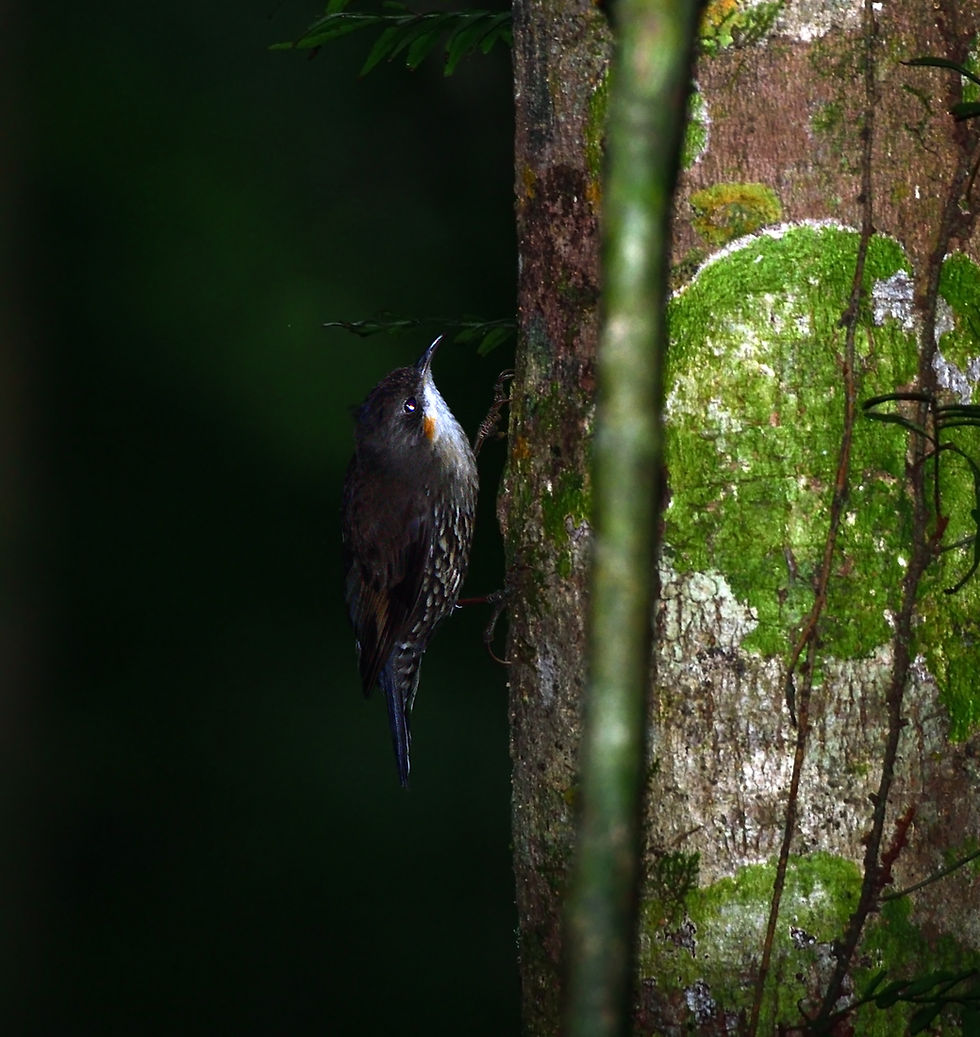
Behind this gathering on a lichen-covered trunk, a White-throated Treecreeper (Cormobates leucophaea) chimes in.
Colin points out a pair of Land Mullets (Bellatorias major), a type of skink, something new for me. It is between this species and the Blue-tongued Skink for the title of largest species in this family.

We travel higher along the escarpment until it thins out and the track ends at Moonlight Crag Outlook. In the distance sits the western McPherson Ranges and before us is a glorious view of the Albert Valley.

Along the cliff of this caldera runs Morans Falls, sitting on the plateau just east is O’Relly’s Rainforest Retreat.


Here eucalypts predominate with an understory layer of a unique tree found only in Australia, the Grass-tree. These specimens I believe are Xanthorrhoea glauca, one of 66 known species.


An interesting design is the trunk, since this plant has no petiole (leaf stalk) that normally attaches to a stem, the base of the leaf grows straight out of the ‘trunk’ – which is formed over time from the stacking of one layer atop the other and is firmly ‘glued’ with its own resin. This close-up image shows the composition’s end result.

Here we find another treecreeper, this being the Red-browed (Climacteris erythrops) with a very different rattling song compared to its rainforest counterpart...

...and another basking Land Mullet off to the side of the trail. I attempt to photograph a Common Brown (Heteronympha merope) butterfly, when it conveniently lands on a signboard that explains the panoramic view before us.

There is a bit of a lull as we head back so I take more time to admire this unique rainforest. Markers posted at the base of more trees allows for easy identification. Many trees have a fluted base, so when I gaze up at each stop, it showcases how difficult it can be to see leaves so high up in the canopy. That is when you utilize other markers such as the color, shape or patterns of the bark, the leaves on the forest floor, and knowing the time of year each tree flowers and bears fruit. For example, the information provided for the Jijiman or Purple Cherry.

Do you see the pigeon up there, about 2 o'clock? (Lol)

Another mixed flock has monarchs,

scrubwrens and a pair of Gray Fantails (Rhipidura albiscapa).

Atop a moss -covered log, is a Long-billed Scrubwren (Sericornis magnirostra) that is either anting or sunning itself.

[Note: Anting behavior is not wholly understood but it is assumed that allowing ants to invade the bird’s raised feathers (or individual ants may be applied directly by the host) is done so to acquire the defensive chemical properties released by the ants. This in turn aids in the protection against parasites, and fungal or bacterial growth.] Now that I mentioned fungus, “Looky here!” A colorful bunch of Orange Pore Fungus (Favolaschia claudopus).

Coming across another registered Booyong tree, this marker helps point out that this specimen has leaflets with three sets of leaves.


A scuffling in the leaf litter makes me turn to find a Gray Fantail, but it was not the source of my distraction. The culprit turns out to be a Logrunner.

Nearby sits a collection of ferns, having fallen from its arboreal foothold.

The pleasant whistling song of a Gray Shrikethrush sings from the shadows.

The Yellow-throated Scrubwren seems to be everywhere, so it is a surprise when I come across its cousin, the White-browed (Sericornis frontalis).

The next stop prior to exiting is spent gazing at the lattice root arrangement of a Buyei Tree or Watkins Fig...


...and the Brush Box Tree.


Even from the road another ‘walk-to-work’ call from the pitta rings out. At this junction I liken it to have more of a teasing quality similar to, ‘Here I am!’ In otherwards, “Try to find me!” Still that is half the fun, the anticipation for that moment. Back at our starting point the locals (birds) seemed to be a tad more muted. I take the opportunity to photograph a Wonga Pigeon...

...when Colin reminds me, “We should have a look at the nearby bower.”
I reflect on my last experience thirty-six years ago; the bird’s stick structure landscaped with small piles containing strips of plastic, bottle tops, even a toy soldier, and all in ‘BLUE!’ Supposedly the color blue further entices a potential mate by reflecting its own garish vestments. Sadly, the days of searching for native flowers, feathers, shells or berries is made simpler by becoming a trash collector - a hoarder of human neglect. I should not be so harsh. Once you see the architect hop in and inspect his creation, such thoughts quickly melt away.

As we head back to the Booyong Trail for another shot at the pitta and lyrebird, a striking Feather-horned Beetle (Rhipicera femorata) flies in and requires a stop for a short photo session. How can you not be distracted by those plumed antennae?

Entering the track we come across the usual suspects: Yellow-throated Scrubwren...

...E. Yellow Robin,

...and a pair of Gray Fantails.


“The pitta! It’s sounds close!” Colin quickly plays back its call. We wait. It responds. Another try. “It’s getting closer." Gingerly we move in the direction of its last response; there is movement in the undergrowth. Colin points down the ravine. I get a glimpse and it continues to walk in line with the trail. I follow suit and manage to get a decent look for a second. I try to capture an image but there is too much obstruction. I am surprised how quickly it moves. It approaches the backside of an assemblage of vegetation which then opens to a large uninterrupted space. I anxiously speed up, pre-focus and wait for it to appear. Nothing - it chose to melt back into the darkness. Still a memorable encounter.

Our confidence has been resurrected. A ways up Colin discovers a ‘scrape’ off the side of the trail; we than hear the tossing of leaf litter. A large shadow looms in the darkness. “Perhaps?!” It is….
….only a brushturkey.

After another ten minutes a decision is made to go back towards the entrance where the lyrebird is regularly found.
After twenty minutes or so, the strut of the lyrebird was not to be had. Stepping out of the shadows and into the light we take our time heading back to the carpark. Sitting between some palm fronds we find a Mistletoe Bird, a first for Colin at this location.

Glancing over the feeding station we find a scrubwren...

...plus a parrot (Female King Parrot) and

a firetail in the trees.

The downward trill of a Fan-tailed Cuckoo (Cacomantis flabelliformis) has our bins pointing towards the treetops. “There it is!”

That is our last new sighting for the day. Besides, things are slowing down (More like these two old ‘farts’ have had enough), but it certainly has been an eventful day.
And as if to see us off, some of the parrots fly in - adding that closing exclamation point to our adventure!


If it was not for the *Birdingpal website, I would not have met Colin, who drove me here today. We have hooked up multiple times visiting nature reserves, public parks and wetlands, too. We learned a lot about each other, sharing experiences from similar birding trips. exchanging stories and having a mutual passion for the outdoors. Colin is a great birder and a knowledgeable naturalist, but most importantly he has become a good friend.
Location: Lamington National Park - Brisbane, Australia Date: November of 2025
* Birdingpal: https://www.birdingpal.org
Bird Checklist: Avibase - Lamington National Park: https://avibase.bsc-eoc.org/checklist.jsp?region=AUql0158
Bird Songs: https://xeno-canto.org/
Identification of flora and fauna: iNaturalist, https://www.inaturalist.org
Where to Bird - Fatbirder: https://fatbirder.com/world-birding/australasia-or-oceania/commonwealth-of-australia/queensland/


Comments