Simply Look Around
- Allan Sander

- Dec 29, 2025
- 13 min read
Updated: Jan 3

Today’s venture may not be a pristine ‘hike in the great outdoors,’ but a walk along fields of rice amid swaths of oak and bamboo offers plenty of activity for hours on end. This quilt work is indicative of the Chiba Prefecture of Japan, which is about a 90-minute drive west of Tokyo. It harbors the Narita International Airport (NRT) that has brought commerce into this farming community. Expansion continues to bulldoze these verdant pastures; however, the remaining countryside still offers a new discovery around every bend.

Typically a plot has a well-manicured garden, often laced with various fruit trees such as persimmon, chestnut and guava. And there is always a colorful array of flowering plants that reflect the heart of its owner. I recall stumbling upon a basal rosette of lavender-blue flowers that had me all google-eyed! A ring of flowers explode from its base, buds of a deeper blue, striped in purple, are clustered in its center. Greenish-yellow bracts cup this artwork as if it were protecting its contents.
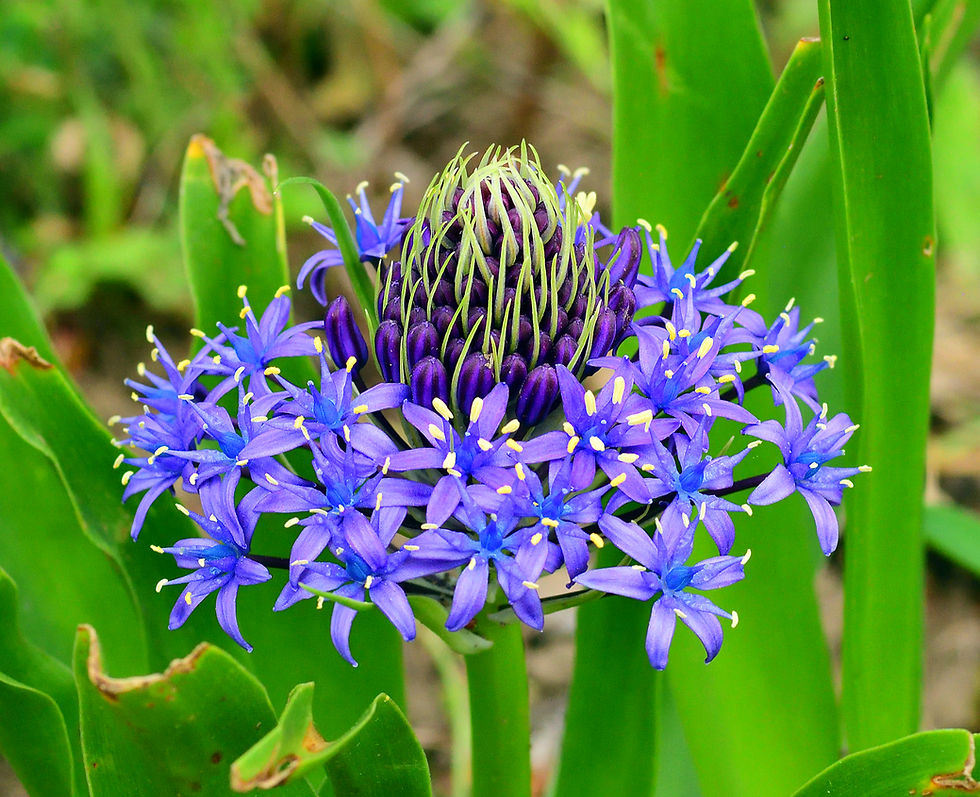
It looks intimidating when viewed from overhead. Its title? Well, it appears it has been so enamored around the globe that one name was not sufficient. Here is a list of common names for Scilla peruviana: Peruvian Scilla, Portuguese Squill, Cuban Lily, Pyramidal-flowered Squill, Hyacinth of Peru, Peruvian Jacinth, Spring Flowers, Spring Bulbs.

As with most flowers, they attract creatures of all sorts and sizes. A clump of Physostegia virginiana (Obedient Plant) reveals sphinx moths White-banded Hunter Hawkmoth (Theretra oldenlandiae) unfurling their tubular mouthparts (called a proboscis) that act like a straw to suck up nectar from each inflorescence it visits.


Various bees, butterflies and beetles are in search of this sugary fluid, too. Flowering Fleabane (Erigeron sp.) brings in a Common Bluebottle (Graphium sarpedon) and

a Small Copper (Lycaena phlaeas).

It seems whenever I cross paths with a Soldier Beetle (Cantharinae) it is inevitably on a yellow flower, today it is on an iris.

With this activity comes a host of predators. The most prolific is the spider, spinning architectural wonders out of silken threads. The orb weavers (Trichonephila clavata) are
the most colorful and well known.

My favorite is the Salticidae, the jumping spiders. They are stout and hairy, and rather than hanging out on a web, they will stalk, and then literally pounce onto their prey! This one is named Carrhotus xanthogramma.

Their eight eyes grouped atop a turret-shaped head aid in collecting data to determine the precise distance required to ‘jump’ onto its next meal! When I lean in close for an image, they respond by elevating for a closer look at my 'one-eyed' lens!

Again, without the use of a web, crab spiders (Family, Thomisidae) often tuck themselves among the petals of a flower or leaf and patiently wait to ambush their prey - having arms splayed in crab-like fashion to quickly grab prey and then subdue it with venom from its fangs. This is a Masked Crab Spider (Thomisus labefactus).

Other plots host fields of wildflowers, a splendid mix of blue, purple and white.

I discover a Diverse Bumble Bee (Bombus diversus) in a small patch of red clover.

Poppies of various hues seem to be a favorite. One field of orange burns intensely with the morning sun.

A hummingbird hawkmoth enjoys an early morning drink of nectar. (Macroglossum species).

After taking a turn, the road heads west leading me through a tunnel where I exit into a colorful battalion of sunflowers. They stand at attention like stick soldiers draped in army-green with their faces fringed in yellow. Nice!

I find it intriguing with our wealth of knowledge, how little we really understand regarding our natural world. Research has its limitations; there is so much that we do not know! With that said, I pride myself in identifying the subjects that I showcase on my website. Often it is narrowed down to the Family, if not the Genus. I feel reassured when I find that some species are so difficult to I.D., that even specialists in their respective fields continue to struggle with categorizing their subjects! For a better understanding, check out this website for identifying *crab spiders: https://www.spiderjoe.com/thomisidae.html

Shards of light pierce through the distant wall of trees, a starburst erupts over the canopy igniting the fields of rice. It is as if a fairy’s wand has transformed each drop of dew into a miniature starburst of its own, and like a crystal ball, magically capturing the scene within.

All sorts of creatures from underwater beetles to aquatic larva, tadpoles

to turtles, frogs and mollusks make the flooded fields a busy affair. At the surface, the winged adults hover in search of prey. This image depicts what is called 'tandem linkage,' of a pair of copulating Common Bluet damselflies (Ischnura senegalensis).

A close relative, a Red Dragon (Sympetrum risi), rests in the shadows.

Slowly I lean over a small culvert and find an interesting surprise, a large Red Swamp Crayfish (Procambarus clarkii). The problem here is that it is also called the Louisiana Crawfish! Yep, a long way from home and exerting more stress on Japan’s native biodiversity.

Let us focus on the native inhabitants, more specifically, the anurans. Three of the four I have come across are endemic to Japan. I bring them up because in late spring they were so numerous that one must take care not to crush the emerging froglets hopping about the water’s edge.

I entertain myself by attempting to spot Rice Field Frogs
(Fejervarya kawamurai) before they leap for safety.
They are cryptically patterned with a warty exterior
and prefer the more open spaces...

...blending in beautifully with their surroundings.

Some have a stripe running from the snout to its tail creating a perfect mirrored image of itself.

The Montane Brown Frog (Rana ornativentris) I would find in fields with forest borders.
The other two frogs merge brilliantly amid the trees and surrounding brush. The Japanese Treefrog (Dryophytes japonica) is the most commonly seen and heard, being found in China and Korea. It generally is a bright green with a brown/black stripe that is barely discernible as it originates at the snout and gradually thickens as it cuts through each eye and ends at the forelimb. At times it will continue along the length of the body.

I have come across some that are gray with irregular dark patches on their back while others were completely brown; there is a lot of variability.


My favorite of the lot is also the least abundant, Schlegel’s Green Treefrog (Zhangixalus schlegelii). It comes in various hues of green with a neon-green being my favorite. Sounds like I’m talking about an automobile doesn’t it? Well a car does ‘not’ have large toe pads however both have a smooth glossy surface. This custom body has a supratympanic fold: a ridge-like layer of skin just above the circular eardrum (…which is external in frogs and is called the tympanum). An irregular mottled brown band separates the chassis from its dirty white under carriage.

All of this biomass brings in the predators such as the heron, egret, or rail.


Gray Heron,
Ardea cinerea
Great Egret
Ardea alba
Another predator-prey scenario, which might be the most 'efficient’ means for obtaining a meal, is the spider’s web! Most of us picture the concentric circles of the Orb Weaver’s design,

however, each web is as unique as its creator.; they are everywhere. “Simply look around!”


Trichonephila sp.

Using its webbing, a jumping spider will stitch a leaf together into a protective chamber to lay its eggs.

Once again, I employ my ‘magic wand’ to reveal what I cannot see. In actuality it is a ‘bamboo stick’ used to wield a quick “Slap!” to branches beyond my reach – little treasures lose their grip and take to the air or freefall to the ground. I follow flitting wings of white until it settles back onto the foliage.

Called, Geisha distinctissima, this planthopper cleverly impersonates a small leaf complete with a network of veins.
Another species, Euricania facialis, uses similar camouflage but its wings are transparent, with dark borders in the shape of a heart.

Another swing and a much larger leaf falls to the ground and magically produces legs! There is no way I would I have found this Japanese Green Bush-cricket (Tettigonia orientalis) perched within the branches.

A real surprise, due to its size, felt like this creature fell from the sky. I was grateful for the discovery but obviously this Japanese Ratsnake (Elaphe climacophora) did not share my enthusiasm!

Sitting motionless, I come across a Meadowhawk (Genus Sympetrum) dragonfly overlooking its territory.

How can one not be mesmerized by those compound eyes! I recall a similar encounter with a Japanese Treefrog (Hyla japonica).

One of my favorite tracks is also the most tranquil - through the years only once have I encountered another soul. There is an old cement path that snakes its way along the edge of an adjoining slope - arching upward towers a wall of cypress and oak, with bamboo rods shooting towards the sky. Too quickly does it thin out, but the dappled rays of light breathe life into the emergent vegetation.

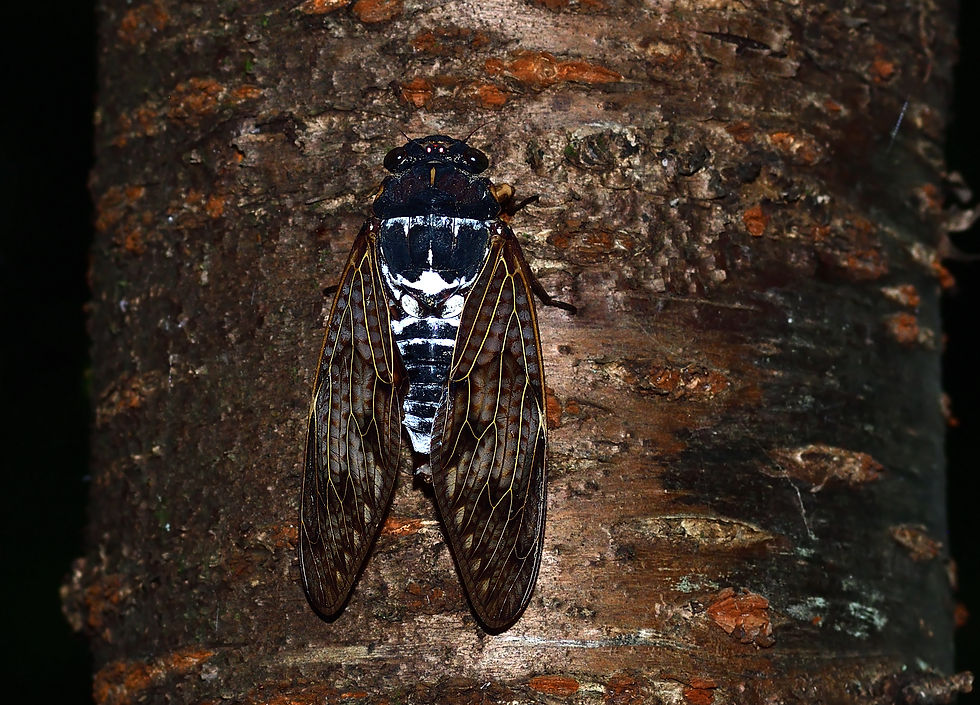
The curtains of filtered light yield a most welcoming scene, as if Mother Nature beckons me to, “Come have a look!” At the base of the incline a farmer has planted cherry, guava, and walnut. Facing a cherry tree, I scrutinize the blistered horizontal lines that split the sheen of the tree’s marbled exterior;

-- cicada song rings out from its trunk. Large Brown Cicada (Graptosaltria nigrafuscata)
Now add the explosive neon-green of a young mantid (Hierodula patellifera)...

...the intricate etchings scrawled across the surface of a snail's shell (Bradybaena pellucida),


...along with the sweet smell of blossoms below, and well, my senses are pleasantly fulfilled.

Carpet Bugle
(Ajuga reptans)
Jerusalum Artichoke
(Helianthus tuberosus)

Moving forward I find several split logs girdled with fungi. Rolling one over reveals other decomposers like roundworms, termites, woodlice, and ants. A surprise find are land snails: small but long, turret shaped and bleached white. Even more whimsical are the Japanese Fairy Millipedes (Niponia nodulose); its serrated backside appearing as if clad in armor.

This brings up the myth of Omukade, an immense centipede with impenetrable armor and strength that it could even vanquish dragons!
As I tread down a set of wooden stairs, swaying blooms of purple and yellow iris welcome me to the “Boardwalk!”

The wooden slats groan in protest under my presence, reflecting the sun’s heat, it attracts a variety of critters. The elongated body and large compound eyes of a robber fly scan the area for an aerial ambush of unsuspecting prey. In Japan it is called "shioya-abu" but in the scientific community it is categorized as, Promachus yesonicus.

Textrix grasshoppers blend beautifully with the weathered gray surface...


...a jumping spider moves in short spurts searching for smaller prey.

An Elephant Hawkmoth caterpillar (Deilephila elpenor) gorges on leaves of purple loosestrife and will eventually spin a cocoon for its winter transition.

Below me a gruesome scene unfolds. Water striders (Gerris latiabdominis) enmass vie for position to feast on an unfortunate victim, sucking its innards dry!

I see a hint of pink further up and as I proceed tiny creatures hop about beneath me. Lying flat on the boardwalk I find "toad bugs!" That is what we call them back home due to their their bumpy exterior and bulging eyes. These little guys have been given the moniker,
Blue-spotted Velvet Shore Bug (Ochterus marginatus) - that's a mouthful for such a little critter!

That pink beacon turns out to be a tiny, beautifully titled orchid called, Austral Ladies'-Tresses (Spiranthes australis).

Heading back to higher ground, I veer off into the shadows – cicada song directs my course towards a large Japanese Walnut (Juglans ailantifolia); its limbs bow to the weight of its bounty.

Like pendants, emerald-green & gold scarabs (Anomala albopilosa) adorn their boughs.


Silken nests of Phalera moth larva add to the carnage.

Slumped across a single fruit, a Schlegel's Treefrog idly digests its fill.

Clumsily turning about flushes a dragonslayer from its perch. Tracing its course it snatches a meal and continues on to dine beyond my line of sight. This leads me to another gathering of Bamboo Moth caterpillars (Artona martini) literally eating themselves out of house and home.

A tree with very odd, irregular shaped fruits would capture anyone’s attention. It is actually an aggregate of fruits of the Kobus Magnolia (M. kobus) that turn from green to dark pink before splitting open to disperse its brilliant red seeds.

In the broken light an assemblage of various flowers flow between the trunks of trees. A single stem with white flowers radiates above large, lance-shaped leaves, this Yabumyoga (Pollia japonica) enjoys growing in patches under such conditions.

Here, too, are scattered blooms of purple Chinese Violet Cress ( Orychophragmus violaceus) with...


...a spike of Big Blue Lilyturf (Liriope muscari) that is about to burst with color!
A flash of orange darts from the forest floor but quickly disappears. Luckily, I followed its course and a closer look reveals a Dark Evening Brown butterfly (Melanitis phedima); it can be easily overlooked as it closely resembles a leaf.

This bright-orange-red psyllid, or jumping plant louse, is called Cacopsylla coccinea. Interestingly, this insect pest is studied by entomologists and plant pathologists for its significance as a vector that transmits harmful plant diseases.

Dressing up the foliage like tiny decorative stones is an assortment of beetles. This bright little fellow is called a Red Leaf Beetle (Lilioceris subpolita).

Up close one can enjoy the shiny irridescent patches of an Oriental Beetle
(Exomala orientalis).

An orange-gold (Agomadaranus pardalis) type seems to have a bit of difficulty keeping its balance.

The most common beetle has a black exoskeleton and a bright orange head and abdomen; it is very skittish and hastily takes to the air when disturbed. Its name is Aulacophora nigripennis.

My steps flush a Spongy Moth and a Brown-striped Semilooper (Lymantria dispar ssp., japonica and Mocis undata). The first moth alights on a rod of bamboo...

...the second drops back into the leaf litter. The Semilooper is so well camouflaged, if I had not followed its course I do not believe I would have relocated it.

Transitional zones, in this case the borders between forest and field, have a greater variety of species. The trees contain organisms specific to the forest along with the shade it provides.
Like a blue necklace skirting the ditches along the forest edge,
blooms a profusion of Asian Dayflowers (Commelina communis).


Flower flies are one of their primary
pollinators.
The long, thin bodies of broad-winged damselflies add a flash of luminescence.
Atrocaloptyrex atrata


It seems where the forest fringe faces east, Kudzu vines (Pueraria montana) rapidly race up towards the crowns of trees. Hanging in clusters is a beautiful purple-pink inflorescence, but it can turn ugly when this plant runs rampant; out-competing native plants and stressing native trees by blocking sunlight and breaking branches due to its weight. It is very prevalent here and I do not know its environmental impact on this region. The trees in the foreground are not discernible as they are completely smothered by vines. The same growth slowly consumes the trees beyond.


The sight and sounds of open fields now draws me in. It is a challenge to identify a group of small butterflies known as ‘Blues.’ Their inner wings flash whimsical shades of blue darting through this sea of green. When they alight, their wings are folded upright. These outer wings are generally silver to grayish-white and host a polka-dot pattern of black. The arrangement and order of these spots is like a code to aid in identification of the species.
Pea Blue (Lampides boeticus)

Pale Grass Blue (Pseudozizeeria maha)

Pea Blue (Lampides boeticus)

Forest Pierrot (Taraka hamada)

Pseudozizeeria maha ssp. argia

Continuing to wander through this verdant ocean offers one revelation after another. With so many types of creatures it is difficult to stay focused.
For instance, here is a group of ‘flies’ I encountered in a ninety minute period:
A Tabanidae species.

Marmalade Hover Fly (Episyrphus baltaetus)

Microchrysa flaviventris, a type of soldier fly.

Atherigona, a type of shoot fly.

Tipuloidea, a type of crane fly.
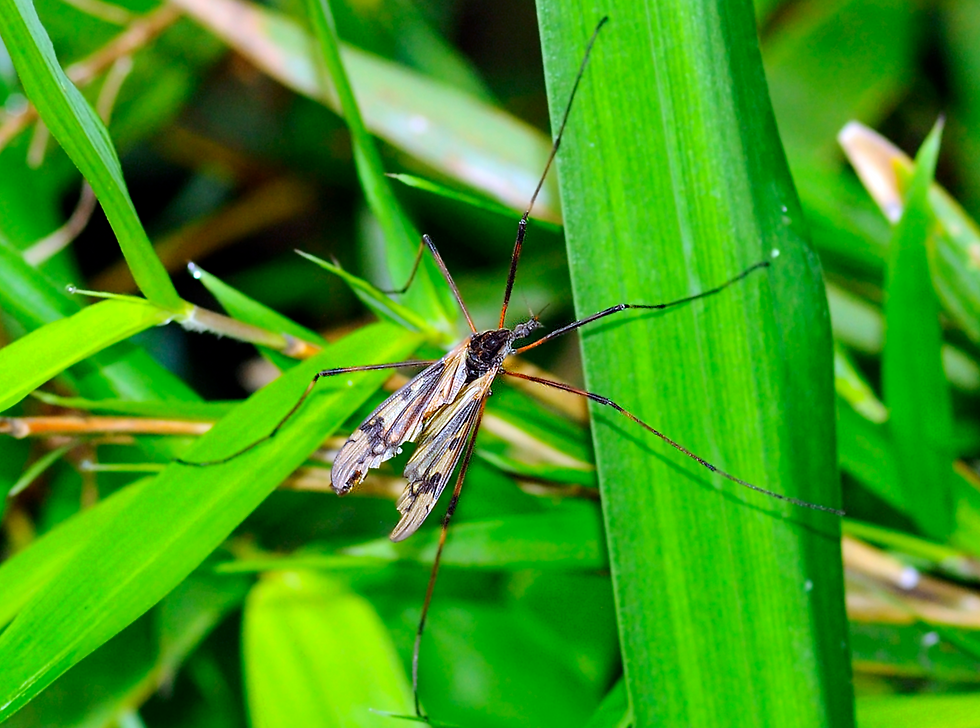
Nephrotoma, a kind of tiger crane fly. This one only has three of its six legs.

Mycetaulus bipunctatus

Common Drone Fly (Eristalis tenax) These flies mimic bees or wasps.

Neoitamus, another kind of robber fly.

Luciliini species.

This encounter is only with one family of insects. Now consider that Japan has currently more than 90,000 classified species of insects found within this island country - so having a fresh encounter goes without saying. Basically, this is true anywhere in the world if you take the time to look around and embrace your surroundings.
I touched on some of the beetles and here are a few more:
There is the small, obscure types like this Club-clawed Darkling Beetle (Subfamily Alleculinae)...

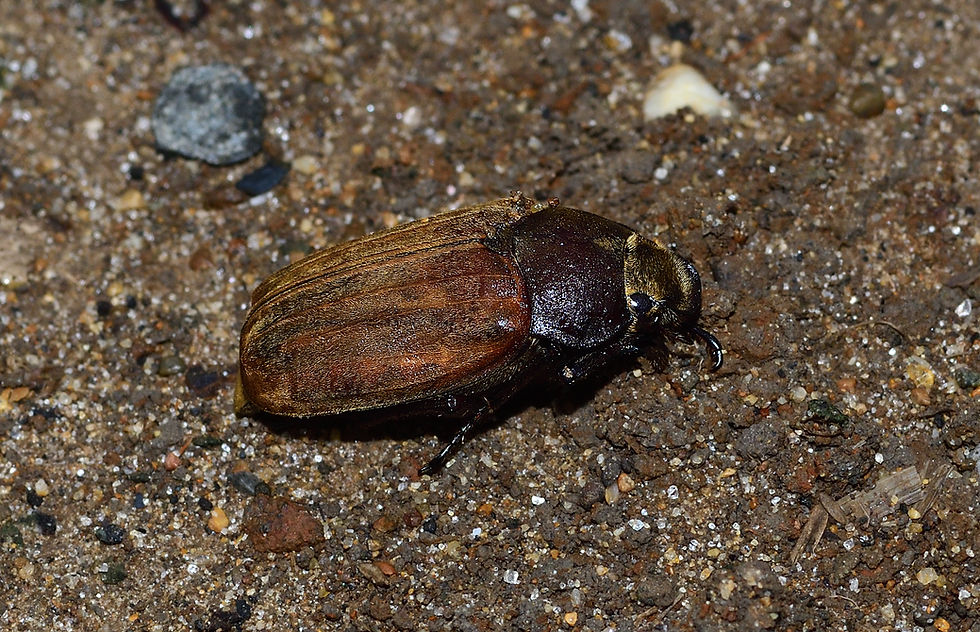
...and the much larger bulky scarabs like this Japanese Cockchafer (Melolontha japonica).
Japan has roughly 180 species of the colorful and commonly known Lady bugs, family Coccinellidae. Here is Aiolocaria hexispilota

Coccinella septumpunctata

The larval state of a ladybug looks nothing like its parent, but it shares its insatiable appetite for consuming aphids.

How about grasshoppers, they are always fun to observe! Generally they can be easy to locate, catapulting into the air when disturbed. One must pay attention to where they land, especially when they spread their wings and take flight.
This is an adult Japanese Grasshopper (Patanga japonica)...

...and this is the immature.

Conocophalus chinensis, a type of conehead katydid.

The bane of the rice farming community, the Rice Grasshopper (Oxya japonica).

And what about those much 'smaller' inhabitants, that due to their numbers, have a much greater impact than one realizes. Now picture how this all becomes food for other insects, frogs, birds, etc. Nature never stops, it goes on 24-7!
Macrosiphini aphids

Here is another kind of aphid being tended by Japanese Queenless Ants (Pristomyrmex punctatus). Remeber I mentioned numbers? Here is a statistic to think about: It is estimated that there are 2.5 million ants for each person on our planet today!

Let us resume our walk as a slight breeze kicks in. I feel like a periscope scanning for an anomaly across the waves. A red beacon appears to bob across the surface; it rises higher revealing the bright red wattles of a Green Pheasant (Phasianus versicolor). I march forward, “Too close!” The bird takes flight exploding from its shelter before submerging back into obscurity.


I have to say, this visit may have been short-lived, but it provided many long-lasting encounters. Nothing complicated, merely a stroll among varied habitats where nature’s bounty takes center stage. “Simply look around!”
Location: Surrounding farm plots adjacent to the Narita International Airport, Narita, Chiba Prefecture, Japan
Date: A consolidation of one trip each in the Spring, Summer and Fall of 2025
*Websites:
inaturalist.org This sight identifies any download of a plant or animal.
https://www.spiderjoe.com/thomisidae.html An example of the difficulty when trying to classify an organism.


Comments