Birding Around Sao Paulo, Brazil


On my most recent trip to southeastern Brazil I hooked up with two local birders/guides via the *Birdingpal website. Gustavo, our driver and interpreter, was joined by his friend and bird guide, Luciano. It was only for a day so being with the local birders allowed for quick identification and saved time getting to the specific birding locations. I came up with 120+ species, not including how many birds were heard – tack on another 30+. At just 'one' of our stops Luciano tallied 110 species! (Granted, many were only heard). It is a country that boasts over 1800 species with such diverse habitats as mountains and grasslands, the famous wetlands of the Pantanal and approximately 60% of the Amazon Rainforest. Sadly, many of these ecological strongholds are now referred as the ‘Once-vast’ Atlantic Rainforest or “Sizable chunks’ of preserved habitat.
The following is a photographic journey from my visit. Parque Ecológico do Tietê is an urban oasis about 30-40 minutes outside the city of Sao Paulo. This was our first stop.
Contributing pollutants from agricultural runoff, sewage and industrial waste for decades has greatly impacted the regions biodiversity - and it still continues. Amid the trash we find various shorebirds like the Black-necked Stilt (Himantopus mexicanus) and...

...Lesser Yellowlegs (Tringa flavipes).

There is also individual A. Golden Plover and Solitary Sandpiper. Another pair of opportunists are some Crested Caracara (Caracara plancus) and Black Vulture (Coragyps atratus).

Gustavo informed me that on his last visit the shoreline was thick with vegetation, obviuosly it was recently cleared out. There were still some interesting finds hidden further back where the brush was untouched. The chatter of a Spix's Spinetail remained hidden but then there was movement - it turned out to be a House Wren. A Green Kingfisher zipped past but my raised camera allowed me to capture a shot of a Picazuro Pigeon (Patagioenas picazuro).

Also wading around in the muck were Southern Lapwings, Snowy Egrets and at first what I thought was a chunk of styrofoam blowing about turned out to be a Masked Water-Tyrant (Fluvicola nengata)!

A cooperative Orange-headed Tanager (Thlypopsis sordida) hung out on the opposite shore.

Bursting with song in a lone tree that survived the onslaught was an energetic Wing-banded Hornero (Furnarius figulas).

Before leaving a Smooth-billed Ani (Crotophaga ani) popped out onto an exposed branch.

We drive further up the road to a large pond where a Brazilian Teal (Amazonetta brasiliensis) conveniently flies in just below our location.

In the tall grass and reeds in front of the pond Luciano points out a Chestnut-capped Blackbird (Chrysomus ruficapillus).

A bit further we overlook a large marshy area with some open water. Gustavo tapes out an excited pair of Yellow-chinned Spinetails (Certhiaxis cinnamomeus).

The aptly named Unicolor Blackbird (Agelasticus cyanopus) flies across our field of vision and lands off to the right. I wish a female would fly in to the scene; she has a brown back, streaked black with a bright yellow throat and chest.

There is so much more flying everywhere with birdsong above and below our vantage point. Oh, I almost forgot about the Green Ibis (Mesembrinibis cayennensis). There were several birds that were feeding far out in the marsh and then flew up to the outer branches of a large tree. They preened and tussled amongst themselves until two birds flew in our direction. Their path took them directly into the morning sun - nothing but silhouettes. One bird remained so I raced down the road anticipating it would follow the same flight pattern. I looked over my shoulder and saw the ibis catapult itself from its perch. I picked up my pace wheeled around and just caught the bird in my viewfinder as it flew overhead.


An hour drive brought us to a wildlife area/park outside of the city of Mogi das Cruzes. This was a vey productive site where most of the birds were heard with plenty seen as well. We park near a forested track adjacent to the marsh where we are greeted by a female Brazilian Teal with two ducklings hot on her tail.

Luciano hears a Sharp-tailed Streamcreeper (Lochmias nematura) and attempts to tape it out from the underbrush. "No luck!" A male Brazilian Tanager (Ramphocelus bresilius) flirts with our cameras, not allowing an open shot, but a not so coy female is more than willing.


Sitting at the top of another tree is a Swallow Tanager (Tersina viridis) and Hooded Siskin (Spinus magellanicus).

I was about to comment on another colorful tanager that flew past, a Violaceous Euphonia, but this colorful family of birds has now been placed with the Fringillids - the Finches. Following its direction allowed a quick glimpse of a Red-ruffed Fruitcrow that made a quick 180 degrees back into the forest. A pair of Lesser Yellow-headed Vultures soar in the distance.
Before entering the forest track we make our way into the marsh.

Sharp 'clicking' sounds leads our eyes to an Orange-breasted Thornbird (Phacellodomus ferrugineigula).


Our search is for a rare endemic, the [Sao Paulo] Marsh Antwren (Formicivora acutirostris); that is the bird on the title page to this article. To eveyone's surprise, we found not only one but five birds - adults with food and feeding its young!


We hear grassquits and seedeaters along with Southern Yellowthroats. Rufous-sided Crakes add to the ensemble. We turn around and off into the woods we go. Someone shouts out, "Ruby-crowned Tanager!" (Tachyphonus coronatus). It is a female, appearing nothing like the male, of which its common name was derived.


I hear the song of a Tropical Parula (Setophaga pitiayumi) and manage a quick shot before it sallies up into the canopy.
We hear so many different calls and songs the further we venture in - it is difficult to keep track of everything. Luciano rattles off each song and it becomes mesmerizing. I point up and he calls out Pallid Spinetail (Cranioleuca pallida); I describe the call as a 'hic-up' chatter.

There was so much to enjoy! Here are some images of the avian participants:
Greenish Shiffornis (Schiffornis virescens)

Yellow-olive Flatbill (Tolmomyias sulphurescens)

Rufous-crowned Greenlet (Hylophylis poicilotis)

Ochre-collared Piculet (Picumnus temminckii)

White-shouldered Fire-eye (Pyriglena leucoptera) - female

Rufous-bellied Thrush (Turdus rufiventris)

Plus an interesting butterfly, Caligo arisbe, belonging to the family of the more well know "Blue Morpho," alights on a blade of grass.

As you saw every image required the use of a flash. I missed some good shots since I did not bring my battery pack to speed up the recycling time.
We pull off onto a road with a large pond on one side and an open field on the other. It is surprising how much bird life there is:
A passionate pair of Streamer-tailed Tyrants (Gubernetes yetapa)...

....cannot get their fill of singing and displaying to one another.


Out on a small spit a pair of Brazilian Teal (Amazonetta brasiliensis) begin to preen themselves. The bird has a beautiful irredescent green-blue inner wing.

Our guides new what was to be found here so the playback of harsh chatter and whistles brought in a Black-capped Donacobius (Donacobius atricapilla) out of the reeds. We immediately stopped the tape as the bird scanned around for the interloper. Before flying back into the reedbed, it proceeded to belt out a few bars in one direction and flip around to do so the opposite way, thusly reclaiming its territory.


Another avian specialist that thrives in this wet glade habitat is the appropriately titled, Yellow-rumped Marshbird (Pseudoleistes guirahuro). We found these birds not too far from this site.


Swinging round to scan the other side, the field reveals many types of finches. It took me a couple of shots while composing to figure out what my subject was, a female Copper Seedeater (Sporophila bouvreuil).

Other seed-eating birds that we found include:
Long-tailed Reed Finch (Donacospiza albifrons)


Blue-black Grassquit (Volatinia jacarina)

Lined Seedeater (Sporophila lineola)


Wedge-tailed Grass-Finch (Emberizoides herbicola)


A stop for lunch, as the afternoon rains kick in, before driving up into an urban protected area of the Parque Estadual de Itaberaba (Itaberaba State Park). The birds seem to rejoice from their afternoon shower; birdsong is heard throughout the forest! We hear Swallow-tailed Manakins everywhere so we feel confident that at least one should make an appearance. Hopes are high to see the Southern Bristle-Tyrant, an uncommon species unique to this area. I thought a bird just flew in until I heard its sharp piping calls then saw it was a Gray-headed Tody Flycatcher (Todirostrum poliocephalum).

In the undergrowth, the distinctive ascending chipping notes of a Sharp-tailed Streamcreeper (Lochmias nematura) ring out. I anticipate its movements and wait with hopes of seeing it pass through a small window. "Got it!"

The plaintive song of another dense-vegetation inhabitant calls from the shadows. Eventually, further ahead, it hops out into a small clearing before melting back into the shadows. Another female White-shouldered Fire-eye (Pyriglena leucoptera).

Gustavo has found a Scale-throated Hermit (Phaethornis eurynome) conveniently perched in a light-gap section of the understory.


All eyes suddenly focus towards the canopy, searching for the source of the slow ascending ‘kwa’ notes of a Surucua Trogon (Trogon surracua). It is one of the more colorful family of birds.


Luciano played the song of the S. Bristle-tyrant for me to help search for the bird, to which one promptly replied! The bird stayed just under the highest canopy and as a result I never managed a decent photo of it. Near the end of our stay a nice Crescent-chested Puffbird (Malacoptila striata) was seen flying about at the mid-level portion of the forest.

Unfortunately, our time was limited so we had to start heading back to the hotel. The manakins continued to be heard but we were unable to find one. Before exiting this rich biodiverse rainforest, a quick stop was made to search for more avian activity. An old homestead tract had gutted the forest leaving open grassland for cattle. These plots were established prior to its National Park status. Cliff Flycatchers (Hirundinea ferruginea) were sallying for insects from an open perch.


A lone White-eyed Parrakeet (Psittacara leucopthalmus) sat atop a lone branch.


One of my last images is quite fitting. At the far side of the pasture a Toco Toucan sits on a tangle of bare branches, just behind it is a set of palm trees. Like us it soon departs, flying across the open glade.

A wonderful day sharing some memorable moments with a great group of people.
Location: Various avian-rich locations outside the city of Sao Paulo, Brazil.
Date: January of 2026
Websites:
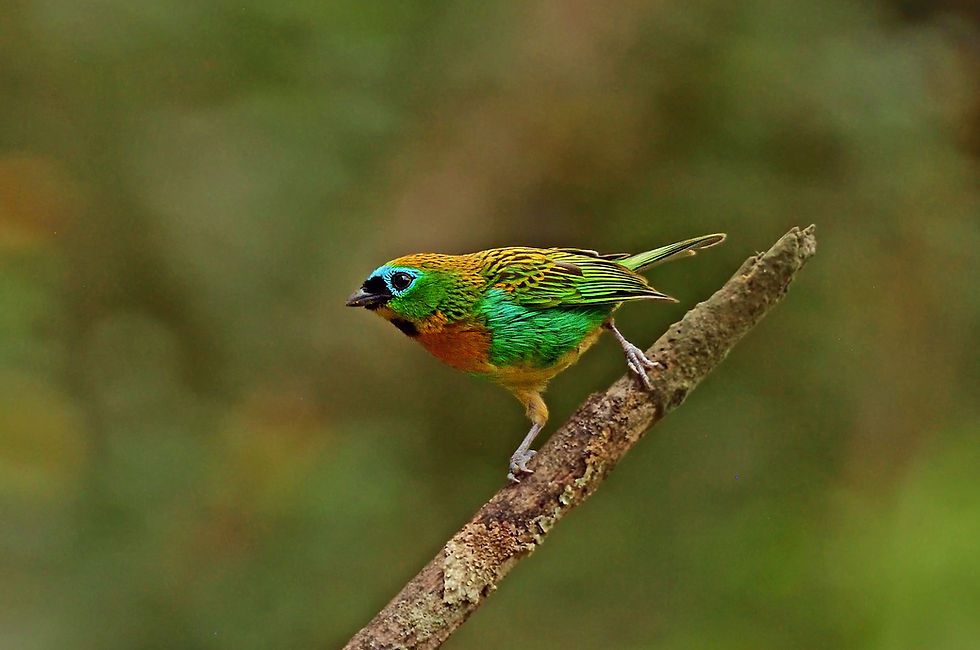


It was a day of birdwatching that will always be remembered with great affection. Sharing the field with my friend Allan Sander made it even more special not only because of our friendship, but also because of the honor of guiding someone so experienced, with an impressive list of birds seen around the world and such a sharp, generous eye.
Our route was carefully planned and took us through landscapes that flowed naturally into one another: peaceful trails, open areas bathed in the soft light of the morning, and forest sections that gradually revealed themselves, always offering surprises. Each stop brought new colors, songs, and encounters that highlighted the richness of the place and the beauty of the journey itself,…