Pesqueira Cantareira - Sao Paulo, Brazil


The plan is to visit the “Pesqueiro Cantareira.” Cantareira is a region north of Sao Paulo, Brazil named after the Cantareira Mountain Range. Pesqueiro translates to ‘fishing spot’ and in this case, it is a pay-to-fish facility. It is adjacent to the Cantareira State Park and is a great introduction to the Atlantic Forest ecosystem. It is only 17km from our hotel but driving in the North-South Corridor can take anywhere from 40-60 minutes! The ponds are fenced in and only open to paying customers. No problem, our interest is around the grounds, especially the forest edge.
To no surprise our first avian encounters are the waterbirds; they lay claim to their own chunk of submerged real estate and allow close observation. There is a handful of Black-crowned Night-herons (Nycticorax nycticorax). This is the adult:

Immature:

with several Snowy (Egretta thula) and a Great egret (Ardea alba),

a lone Cocoi Heron (Ardea cocoi) and...

...two species of kingfisher – Amazon and Ringed (Megaceryle torquata).

The buzzing feeding calls of Plain Parakeets (Brotogeris tirica) leads my eye up to a fruiting Jussara Palm (Euterpe edulis). This palm is unique to the Mata Atlantica (Atlantic Forest) in Brazil.

A Creamy-bellied Thrush (Turdus amaurochalinus) appears nearby, I wait for it to burst into song as it rears its head back but it seems it might be scoping out the palm fruits instead.

Broken avocado fruits, chunks of ripe banana and orange halves are staged on a platform and skewered on bare tree limbs to attract more avian activity. Birds appear high up in the trees but are wary of the local feline and withdraw from coming down. Still we manage good looks above of Ruby-crowned (Tachyphonus coronatus) and...

...Swallow Tanagers (Tersina viridis); this is the male

and the female.

along with a very high-up Blue-headed Chlorophonia (Chlorophonia occipitalis) and a Blue Dacnis (Dacnis cayana) in the shadows.

Across the pond the “Who cooks for you?” song of (Patagioenas plumbea), a Plumbeous Pigeon rings out. We replay its song and it flies in directly above our location.

Then a series of, 'weet,weet,weet' notes diverts our attention towards the other pond. Up high we find the little songster, a Rough-legged Tyrannulet (Phyllomyias burmeisteri).

This pond harbors an Amazon Kingfisher with several Neotropicant Cormorants (Nannopterum brasilianum) basking in the morning sun.

Behind is an area filled with Avocado trees. The fallen fruits that are split open are large enough to swallow up the various frugivorous tanagers! Most prevalent are Blue Dacnis,
Male -

Female -


with some Sayaca, and a Black-goggled Tanager (Trichothraupis melanops) that makes a quick stop. We were informed that various thrushes would be present, however, the picnic benches and a hammock were occupied by the noisy ground staff; so the birds stayed within the sanctity of the forest.
A lone, Maroon-bellied Parakeet (Pyrrhura frontalis) is sighted before we immerse ourselves into the Mata Atlantica.

This wooded area’s charm is enhanced by the melodic songs of thrushes.

The beauty of a Heliconius butterfly (H. ethila) is revealed as it alights briefly for a quick snapshot.

Also in the understory is Heliconia farinosa, it boldly stands out with its deep red ‘lobster-claws,' which are modified leaves called bracts.

The raucous calls of Scaly-headed Parrakeets (Pionus maximiliani) pass over the canopy.
Breaking out into another clearing we encounter a cooperative Southern Tropical Pewee (Contopus cinereus).


This allows for another staging area for a fruit smorgasbord.

Our first guest to arrive is a Bananaquit (Coereba flaveola); it is probably the most familiar bird in the tropics, hustling about in gardens in search of fruit and nectar.


Several Blue Dacnis hop in.


It seems news has reached the airwaves with a female Ruby-crowned Tanager and Chestnut-bellied Euphonia (Euphonia pectoralis) joining the festivities. I had hoped a male euphonia would show up (*That is another superbly-colored bird.) but this a great opportunity just the same.

I now get anxious once I notice a kaleidoscope of color lurking in the understory. One bird ‘bursts’ onto the scene – talk about making an entrance! It seems the Brassy-breasted Tanager (Tangara desmaresti) was left to its’ creator's imagination, mixing swatches of colors haphazardly with an end result that is nothing short of spectacular!


Above us a Southern Beardless Tyrannulet (Camptostoma obsoletum) calls out with a warbling trill.

We stay as long as the birds have their fill and move on. Downhill a woodcreeper slices through the trees, landing on the backside of a nearby trunk. Before I can get close enough it has already dropped down into the shadows. A similar looking bird flies in and I am able to make out a creamy eyebrow stripe and white cheek stripe and streaked crown. The wedge-shaped bill confirms it's I.D., Streaked Xenops (Xenops rutilans). Black vulture (Coragyps atratus) sky silhouettes lead us back out to the entrance road.

Hugging this rock covered lane is a cement culvert, probably the source of water for the ponds. It is shallow and has a very slow current. A Southern House Wren (Troglodytes musculus) at its rim gets our attention.

This leads us to follow the drainage downstream where a pair of Swallow Tanagers are taking a bath. Again, the sexual dimorphism:
Male is a variable turquoise blue with a black forehead, mask and throat. Flanks barred black.


Female is grass green above yelllow below with flanks barred green.


Further along a high-pitched whistle has all eyes trailing up the wooded edge. Playing a game of tag is a pair of Yellow-olive Flatbills (Tolmomyias sulphurescens).

Their energy is infectious as a couple of Buff-fronted Foliage-gleaners (Dendroma rufa) make their debut.
The open space of a carpark is our next stop. Vultures and parakeets coast overhead. In the distance, I catch a fleeting view of bright orange wing patches from a Roadside Hawk (Rupornis magnirostris). A Surucua Trogon (Trogon surrucura) sounds like a whimpering dog singing in the canopy. A bird comes in but stays high up in a towering pine.
(This image was from a prior visit in another part of Sao Paulo State).

I was hoping the birds were interested in the nearby Embauba or Cecropia Tree's (Cecropia glaziovii) ‘gummy worm fruits’ that were highlighted in the sun.

Back to our first stop - still no activity at the feeders (I say this as 'kitty' cozies up against my leg). Listening and looking for our aerial acrobats, I take the time to photograph one of the many domesticated Red Junglefowl (Gallus gallus) on the premises.

Violet petals from a Sky Flower (Duranta erecta) bush attract another Heliconius ethila and a Swallowtail butterfly, Battus polystictus,


I hear my name and another Rough-legged Tyrannulet is spotted. This time it is resting in a bush at eye level. This is one of those great photo ops, but my position has the tiniest branch cutting across its forehead – “Oh, so close…!”

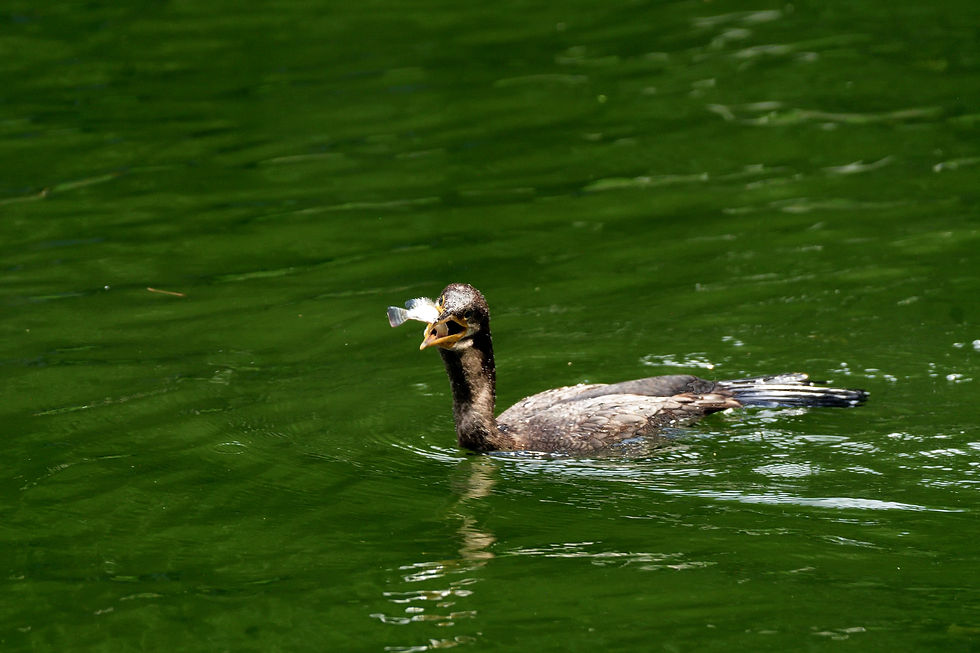
Behind this encounter I see a cormorant has just caught a fish. I attempt to capture the sequence of how it realigns its prey before it swallows it whole. You can see how that sharply hooked upper mandible maintains a tight lock on the fish.


It continues to realign the fish so it faces head first.

This allows the bird to swallow it whole as the dorsal and pectoral fins slide back in the process.
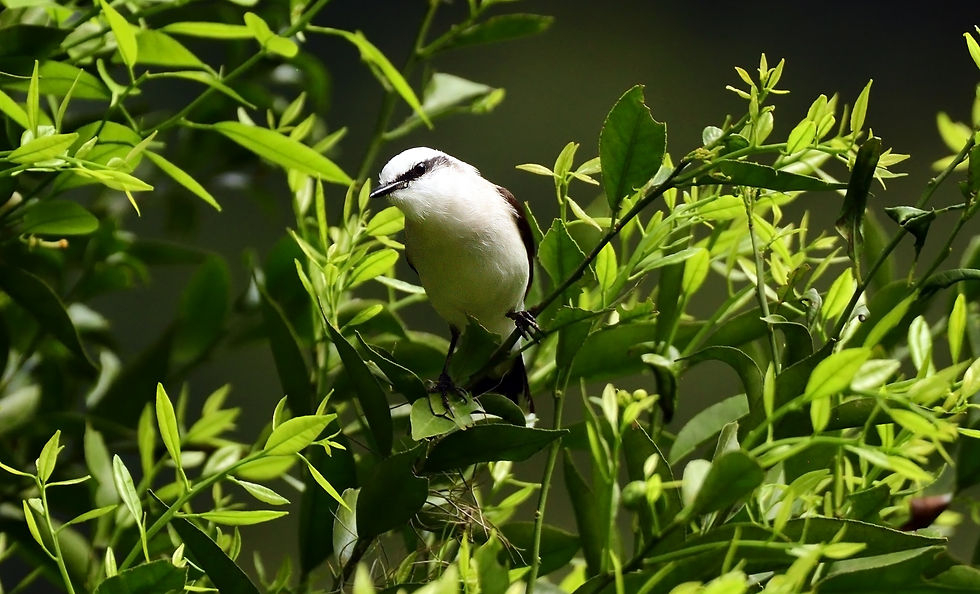
Looking around I find activity in a small thickly leafed tree. It turns out to be an ideal
As we are packing up our gear, I hear my name again and Luciano is waving for us to come over; he points up towards a palm tree. Among the fronds is a Gold-chevroned Tanager (Thraupis ornata).


“Obrigato, Luciano!” It always feels too soon to call it a day but as always, each moment was greatly appreciated. Until next time, “Embrace the moment!”
Location: Pesqueiro Cantareira, State of Sao Paulo, Brazil
Date: August of 2026
Websites: * https://ebird.org/species/chbeup1?continue


Comments